Chinese Mythology Creatures: Dragons, Beasts and Spirits
A field guide to the creatures of Chinese myth, group by group, with the oldest text for each and links to the full entries and original art.
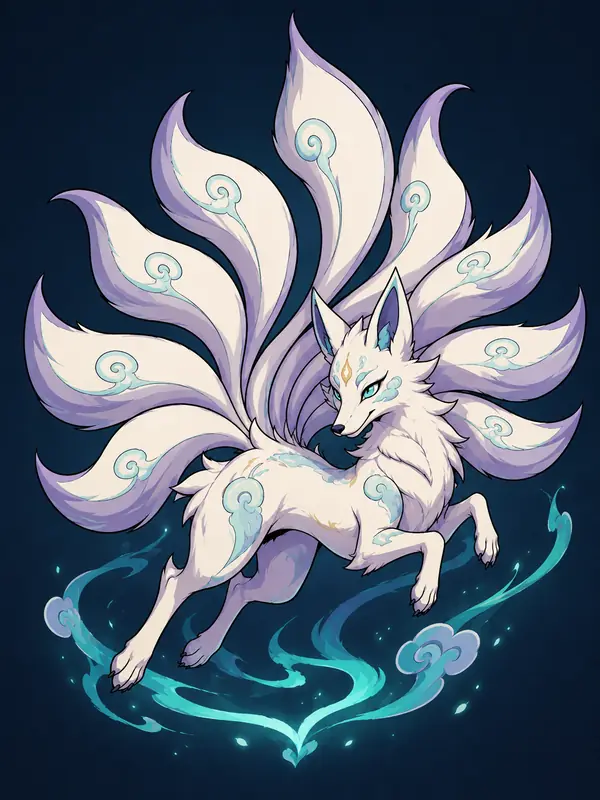
- Chinese name
- 神兽 (shénshòu)
- Also known as
- Chinese mythical creatures, Chinese legendary beasts
- Type
- Overview of creatures
- Famous groups
- Four Symbols, Four Benevolent Animals, Four Perils
- Key sources
- Shan Hai Jing, Zuo Zhuan, Book of Rites, Zhuangzi
- Linked to
- The five elements and the four directions
- In our bestiary
- 43 creatures with original art
What counts as a creature in Chinese mythology?
Chinese mythology creatures range from the dragon, the most famous of all, to beasts known from a single line in an ancient geography. Some are sacred animals that stand for the directions and seasons. Some are omens: see them and the harvest will be good, or the town will burn. Some are villains, and a few are later folk monsters that grew up in ghost stories only a few centuries ago.
There is no single list. The groups below come from different books and different periods: ritual texts such as the Book of Rites, histories such as the Zuo Zhuan, the Shan Hai Jing or Classic of Mountains and Seas, Daoist philosophy, and popular belief. For each creature we say where it first appears and link to its full page: the Shan Hai Jing bestiary for beasts from that book, with original art, and this encyclopedia for the great figures such as the dragon and the qilin. The line between a creature and a god is often blurred. Many Shan Hai Jing "beasts" are called gods in the text itself, and the gods they serve are covered in our guide to the Chinese gods.
Dragons and dragon kin
The long, the Chinese dragon, is a scaled creature of water and sky that brings rain and later became the emblem of the emperor. Unlike the dragons of European legend, it is usually a benevolent power rather than a monster to be slain. The written character for dragon already appears on Shang dynasty oracle bones, and dragon shapes are older still. Our dragon entry follows it from the earliest texts through the nine sons of the dragon and the Dragon Kings of the four seas.
Yinglong is a dragon with wings and the bringer of rain. The Shan Hai Jing says it fought for the Yellow Emperor against Chiyou and could never return to heaven afterward, so people made its image to call down rain in times of drought.
大荒东北隅中,有山名曰凶犁土丘。应龙出南极,杀蚩尤与夸父,不得复上。故下数旱,旱而为应龙之状,乃得大雨。
In the northeast corner of the Great Wilds is a mountain called Xiongli Earth Hill. Yinglong dwells at the southern pole: it slew Chiyou and Kuafu and could not rise to heaven again. So the land below often suffers drought; in drought, people make Yinglong's likeness, and great rains come.
Zhulong, the Torch Dragon, is a red god with a human face and a snake's body in the far north. When it opens its eyes it is day and when it closes them it is night, and it lights a land the sun never reaches.
The jiao is a lesser water dragon, usually pictured without horns, that lives in rivers and deep pools and raises floods. Early dictionaries class it as a kind of dragon, and later tradition says a jiao that survives long enough can become a true dragon. Killing one was a hero's feat: a well-known story tells how Zhou Chu, a young troublemaker of the Jin dynasty, killed a tiger and a jiao before reforming his ways.
The Four Symbols
The Four Symbols, sixiang, are four sacred animals that guard the four directions of the sky. Each rules one quarter of the heavens, made up of seven of the twenty-eight lunar mansions that ancient Chinese astronomers used to track the moon, and each is tied to a season and a color.
- The Azure Dragon, Qinglong: east, spring, the color blue-green.
- The Vermilion Bird, Zhuque: south, summer, red.
- The White Tiger, Baihu: west, autumn, white.
- The Black Tortoise, Xuanwu: north, winter, black. It is shown as a tortoise wrapped in a snake.
The four were fixed as a set by the Han dynasty. Round roof-end tiles from Han palaces each carry one of the four animals, and Han bronze mirrors arrange them around the center like the four sides of the world. They were painted on the walls of tombs to protect the dead, a practice that continued for centuries. Systems based on the five elements sometimes add a fifth animal, often a yellow dragon, for the center and the element earth. The Black Tortoise later became the Daoist god Zhenwu, the Perfected Warrior, one of the clearest cases of a sacred animal turning into a god.
The Four Benevolent Animals
A different set of four comes from the Book of Rites, a Confucian collection on ritual compiled in the Han dynasty from older material. It calls the qilin, the phoenix, the tortoise and the dragon the four spirit animals, or four benevolent animals, and says that when a sage rules well, the phoenix and qilin come to the outskirts of his capital and the tortoise and dragon to its palace pools. With the dragon tamed, it adds, the fish do not scatter; with the phoenix, the birds do not take fright; with the qilin, the beasts do not bolt.
何謂四靈?麟、鳳、龜、龍,謂之四靈。
What are the four spirit creatures? The lin, the feng, the tortoise and the dragon: these are called the four spirit creatures.
The qilin is a gentle, hoofed beast with a single horn that will not tread on living grass. Its appearance marks the birth or reign of a sage. The Spring and Autumn Annals, the chronicle tradition links to Confucius, ends with the capture of a lin, and later readers took this as a sign of the sage's own end.
The fenghuang, the Chinese phoenix, is a five-colored bird like a rooster. In the Shan Hai Jing the markings on its body spell out virtues, and when it appears the world is at peace. Later it became the partner of the dragon, standing for the empress.
The tortoise is the most down-to-earth of the four, but its shell was among the most sacred objects in early China. Shang dynasty diviners cracked turtle plastrons with heat and read the answers of the ancestors in the cracks, which is why so much of the oldest Chinese writing is on turtle shell. Later tradition says a turtle rose from the Luo River with a magic number square on its back. In the Shan Hai Jing the Xuangui is a strange turtle with a bird's head and a viper's tail. The fourth animal, the dragon, is covered above.
The Four Perils
The Four Perils, sixiong, are the opposite of the spirit animals: four villains the sage king Shun drove out to the edges of the world. The oldest account is in the Zuo Zhuan, a history of the Spring and Autumn period, under the eighteenth year of Duke Wen. There they are four worthless sons of noble clans, each given a nickname by the people. Later tradition turned the nicknames into monsters.
舜臣堯,賓于四門,流四凶族,渾敦、窮奇、檮杌、饕餮,投諸四裔,以禦螭魅。
When Shun served Yao, he received guests at the four gates. He banished the four wicked clans, Hundun, Qiongqi, Taowu and Taotie, and cast them out to the four borders to hold back the demons of the wilds.
- Hundun, chaos: in the Zuo Zhuan a son of the Dihong clan who hid wrongdoers. The Shan Hai Jing has a faceless god, Dijiang, described with the same word, and the Zhuangzi tells of the emperor Hundun who died when he was given a face.
- Qiongqi: a son of the Shaohao clan who broke faith and dressed up wicked words as fine speech. The Shan Hai Jing describes it as a man-eating ox with hedgehog bristles, and later as a winged tiger.
- Taowu: a son of Zhuanxu who could not be taught and would not listen. It has no Shan Hai Jing entry; later books of marvels picture it as a huge tiger-like beast with a human face and a long tail. The word came to mean a stubborn villain, and it was also used as the name of a historical chronicle.
- Taotie, the glutton: a son of the Jinyun clan greedy for food and wealth. Its name also labels the staring monster face on Shang and Zhou bronzes, and the commentator Guo Pu identified it with the man-eating Paoxiao of the Shan Hai Jing.
Beasts of the Shan Hai Jing
The Shan Hai Jing is the great storehouse of Chinese mythology creatures. Book by book it walks through mountains and distant lands and lists what lives there, usually in a few lines: what the creature looks like, what its cry sounds like and what happens if you see it or eat it. Our bestiary covers 43 of them, each with the original text and our translation. A few of the best known:
The nine-tailed fox lives on Mount Qingqiu in the first book of the Southern Mountains. Long before it became the fox spirit of later stories, it was a man-eating beast whose flesh protected against curses.
有兽焉,其状如狐而九尾,其音如婴儿,能食人,食者不蛊。
A beast lives here, like a fox with nine tails and a cry like a baby's. It eats people. Whoever eats it is safe from curses.
- Jingwei: the drowned daughter of the Flame Emperor, turned into a small bird that carries twigs and stones to fill the Eastern Sea.
- Bifang: a one-legged crane whose appearance means strange fires in its town.
- Lu Wu: a god with a tiger's body and nine tails who keeps Kunlun, the Heavenly Emperor's capital on earth.
- Tianwu: the eight-headed Lord of the Waters, with eight human faces, eight legs and eight tails.
- Kui: a one-legged, hornless ox that glows like the sun and moon and roars like thunder. The Yellow Emperor made a drum from its hide.
- Dangkang: a tusked pig that calls its own name. When it appears, the whole world has a good harvest.
- Bashe: a giant snake that swallows an elephant and spits out the bones after three years.
- Xingtian: a giant who fought the Heavenly Emperor and lost his head, then kept fighting with his nipples for eyes and his navel for a mouth, holding a shield and an axe.
- Xiangliu: the nine-headed minister of the water god Gonggong. Yu the Great killed him, and his blood was so foul that no grain would grow where it soaked the ground.
Bai Ze, the all-knowing beast that described every spirit in the world to the Yellow Emperor, is often listed with these creatures, but it does not appear in the Shan Hai Jing; its story comes from a later Daoist collection.
Lucky beasts: pixiu and Nian
The pixiu is a winged, lion-like beast that is said to eat gold and silver and never let any out, which made it the favorite charm of anyone hoping to keep their wealth. The Records of the Grand Historian already names the pixiu among the fierce beasts the Yellow Emperor trained for war; the money-keeping pixiu of bracelets and desk statues is a much later development of folk belief. Pairs of similar guardian beasts, often called bixie, stand outside Han and later tombs to drive away evil.
The Nian is the monster behind the Chinese New Year. In the story told today, it came out of the sea or the mountains at the end of every year to eat crops, animals and people, until the villagers discovered that it feared the color red, loud noise and fire. That is the folk explanation for red decorations, firecrackers and staying up on New Year's Eve. The word nian means year, but no ancient text records the beast; the story seems to be quite recent, and it spread widely only in modern times.
Later folk monsters: jiangshi, fox spirits, Kun and Peng
The jiangshi is the stiff, hopping corpse of Chinese ghost stories. Tales of corpses that rise and attack the living appear in Qing dynasty collections of strange stories by writers such as Ji Yun and Yuan Mei. Folk belief explained that a corpse could rise if it absorbed too much yin energy or if the soul failed to leave the body. The familiar image, with the arms held straight out, a Qing official's hat and a paper charm stuck to the forehead, owes much to Hong Kong films of the 1980s.
Fox spirits, huli jing, are foxes that live long enough to take human form, most often as a beautiful woman. They can be dangerous seducers or loyal companions. They fill the Qing dynasty collection Strange Tales from a Chinese Studio by Pu Songling, and the most famous of them, Daji of Investiture of the Gods, is often pictured with nine tails. Their ancestor is the nine-tailed fox of the Shan Hai Jing.
Kun and Peng are the giant fish and bird that open the Zhuangzi, the Daoist classic of the 4th century BCE. The fish Kun, thousands of li long, turns into the bird Peng, whose wings are like clouds hanging from the sky, and which flies to the southern sea on the great winds. The story is a parable about scale and freedom, and "Kun-Peng" is still used for something of vast ambition.
北冥有魚,其名爲鯤。鯤之大,不知其幾千里也,化而爲鳥,其名爲鵬。
In the northern darkness there is a fish, and its name is Kun. Nobody knows how many thousand li the Kun measures. It changes into a bird, and its name is Peng.
Creatures and the five elements
In Han dynasty thought, almost everything was sorted by the five elements, or five phases: wood, fire, earth, metal and water. Each element goes with a direction, a season and a color, and the sacred animals fit into this scheme. The Azure Dragon is wood and the east, the Vermilion Bird fire and the south, the White Tiger metal and the west, the Black Tortoise water and the north, and a yellow dragon or, in some versions, the qilin takes the center and earth. Rain dragons belong with water, and fire birds such as the bifang with fire.
The elements also generate and overcome one another in fixed cycles: wood feeds fire, fire makes earth, earth bears metal, metal carries water and water nourishes wood, while water quenches fire, fire melts metal, metal cuts wood, wood breaks earth and earth dams water. This idea of creatures with elemental natures, strong against one and weak against another, is one of the most lasting legacies of Chinese mythology.
The creatures in Beasts of Shanhai
All 43 creatures in our bestiary are also units in Beasts of Shanhai, our free browser auto battler set in the world of the Shan Hai Jing. Each beast belongs to one of the five elements, and the counter cycle above decides who has the advantage. Yinglong, Jingwei and Tianwu are Water, the Fenghuang, Bifang and Zhulong are Fire, the nine-tailed fox is Wood, Qiongqi and Lu Wu are Metal, and Taotie and Hundun are Earth.
We built each beast's skill from its oldest text: the nine-tailed fox charms, Taotie eats the fallen, Hundun silences, and Jingwei refuses to give up. Read the original lines in the bestiary, browse the rest of the Chinese mythology encyclopedia, then build a team and see how the old creatures fight.
Questions
What are the main creatures of Chinese mythology?
The dragon, the phoenix (fenghuang), the qilin and the tortoise, the Four Symbols of the directions, the Four Perils such as Taotie and Hundun, the nine-tailed fox and the many beasts of the Shan Hai Jing.
What are the four guardian beasts of China?
The Four Symbols: the Azure Dragon of the east, the Vermilion Bird of the south, the White Tiger of the west and the Black Tortoise of the north. They were fixed as a set by the Han dynasty.
What is the difference between the Four Symbols and the Four Benevolent Animals?
The Four Symbols guard the four directions of the sky. The Four Benevolent Animals of the Book of Rites, the qilin, phoenix, tortoise and dragon, are sacred creatures that appear under a good ruler. Only the dragon is in both sets.
Are Chinese mythology creatures good or evil?
Both. The qilin and phoenix are signs of peace, the Four Perils are villains, and many Shan Hai Jing beasts are simply omens: some bring harvests, others fire, flood or war.
Is the Nian a real ancient legend?
It is a popular folk story about the New Year, but no ancient text records it. The version told today appears to be recent and spread widely only in modern times.
What is the most powerful creature in Chinese mythology?
Most people would say the dragon, the bringer of rain and emblem of the emperor. In the Shan Hai Jing, cosmic beings such as Zhulong, whose eyes make day and night, are even more powerful.
Where do Chinese mythical creatures come from?
Mostly from ancient texts: the Shan Hai Jing, the Zuo Zhuan, the Book of Rites and the Zhuangzi, plus Han dynasty art and later folk tales. Each entry here names its source.
Related entries
- Chinese DragonCreatureThe long: a scaled spirit of water and rain that can shrink or grow at will, chief of all scaly creatures and the emblem of the emperor.
- QilinCreatureA one-horned beast of perfect kindness that appears only under a wise ruler. One of the four spirit animals, and a bringer of sons.
- PixiuCreatureA winged lion-like beast said to swallow wealth and never let it go. In the oldest texts it was a fierce animal and a symbol of brave troops.
- Chinese GodsOverviewThe main Chinese gods by group: creators, sage kings, the Daoist heaven, Buddhist figures, gods of wealth and war, and the moon goddess Chang'e.
From the Shan Hai Jing bestiary
 Nine-Tailed Fox 九尾狐A fox with nine tails and a cry like a baby's. It eats people, and eating it keeps curses away.
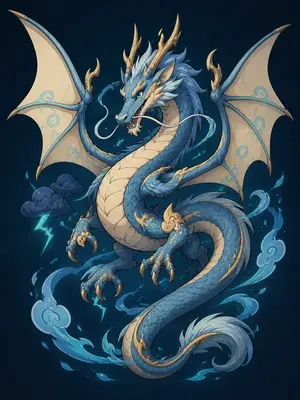 Yinglong 应龙A winged dragon that stores the rains. It killed Chiyou and Kuafu and now lives at the southern pole.
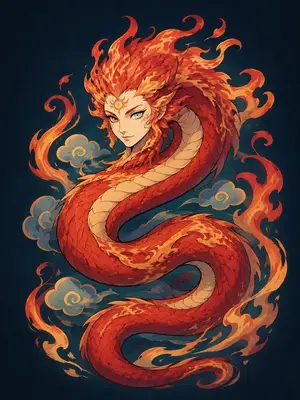 Zhulong 烛龙A red god with a human face on a snake's body. Opening its eyes makes day; closing them makes night.
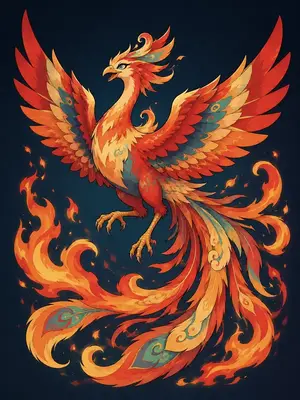 Fenghuang 凤皇A five-colored bird like a rooster whose markings spell out virtues. When it appears, the world is at peace.
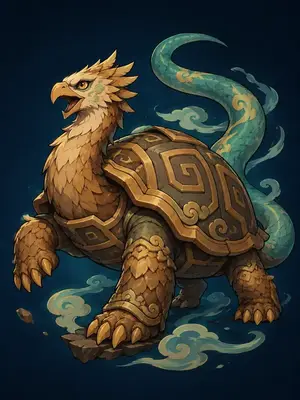 Xuangui 旋龟A turtle with a bird's head and a viper's tail, whose voice sounds like splitting wood. Wearing it keeps deafness away.
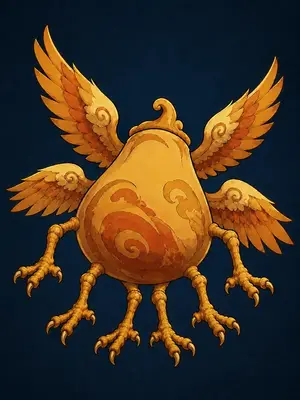 Hundun 混沌A faceless god like a red sack, with six legs and four wings. It has no eyes, yet it knows song and dance.