Chinese Gods: Who's Who in the Chinese Pantheon
From the creator Pangu to the Kitchen God over the stove: the main Chinese gods, where each one first appears, and how the old layers of myth, Daoism, Buddhism and folk belief fit together.
- Chinese name
- 诸神 (zhū shén)
- Also known as
- Chinese deities, Chinese pantheon
- Type
- Overview of the gods
- Main traditions
- Ancient myth, Daoism, Buddhism and folk religion
- Head of heaven
- The Jade Emperor, in popular religion
- Key sources
- Huainanzi, Shan Hai Jing, Records of the Grand Historian, Ming dynasty novels
- Still worshipped
- Yes, in temples and homes across the Chinese-speaking world
How the Chinese gods fit together
Chinese gods do not come from one family tree or one holy book. There is no Chinese equivalent of a single genealogy of the gods. Instead, the Chinese gods people know today come from at least four layers laid on top of each other over more than two thousand years.
The oldest layer is ancient myth: creators such as Pangu and Nuwa, and the sage kings and culture heroes who taught people to farm, heal and control floods. The second layer is Daoism, which from the Han dynasty onward organized gods into a heavenly government with ranks, offices and paperwork, much like the imperial court on earth. The third is Buddhism, which arrived from India in the first centuries CE and brought figures such as Guanyin and the kings of the underworld, who were slowly made Chinese. The fourth is folk religion: local heroes, deified officials and household gods worshipped in villages and homes, often with no scripture at all.
These layers mixed freely. A single temple can hold the Jade Emperor, Guanyin and Guan Yu side by side. The Ming dynasty novels Journey to the West and Investiture of the Gods then gave many gods the personalities and stories most people know today.
Creator gods: Pangu, Nuwa and Fuxi
Pangu is the god who separated sky from earth, but his story is later than many people think. It comes from the Sanwu Liji, a third century book by Xu Zheng. That book is lost. What survives are quotations in later works, above all the Yiwen Leiju, a Tang dynasty encyclopedia compiled in the 7th century. In the quoted passage the universe begins as an egg, Pangu grows inside it for eighteen thousand years, and the light and heavy parts separate into heaven and earth.
天地混沌如雞子,盤古生其中。萬八千歲,天地開闢,陽清為天,陰濁為地。盤古在其中,一日九變,神於天,聖於地。
Heaven and earth were a blur like a hen's egg, and Pangu was born inside it. After eighteen thousand years heaven and earth opened apart: the bright and clear became heaven, the dark and murky became earth. Pangu was between them, changing nine times a day, divine in heaven and sage on earth.
A second, better-known part of the story, in which Pangu's breath becomes the wind, his eyes the sun and moon and his body the mountains, is also credited to Xu Zheng and survives only in later collections.
Nuwa is much older in the written record. The Songs of Chu already ask about her, and the Huainanzi, a Han dynasty book of the 2nd century BCE, tells the story of how she mended the broken sky. After the pillars of the world collapsed, she patched the sky, propped up its corners and stopped the flood with the ashes of reeds.
往古之時,四極廢,九州裂,天不兼覆,地不周載……於是女媧煉五色石以補蒼天,斷鼇足以立四極。
In ancient times the four pillars of the world broke down and the nine provinces split open. The sky no longer covered everything and the earth no longer held everything up. … So Nuwa smelted stones of five colors to patch the blue sky, and cut off the legs of the great turtle to set up the four pillars.
The story of Nuwa shaping the first people from yellow clay comes from a different source, the Fengsu Tongyi, a late Han book by Ying Shao, which survives only in quotations in later encyclopedias. Tired of shaping each person by hand, she drags a rope through the mud, and the drops become people.
Fuxi is often paired with Nuwa. The Book of Changes credits him with drawing the eight trigrams and teaching people to make nets for hunting and fishing. In Han dynasty tomb carvings Fuxi and Nuwa appear as a couple with human upper bodies and snake tails twisted together, one holding a carpenter's square and the other a compass.
Sage kings and culture heroes
Shennong, the Divine Farmer, taught people to plant grain and to tell healing plants from poisonous ones. The Huainanzi says he tasted the hundred plants and was poisoned seventy times in a single day. He is often identified with the Flame Emperor, Yandi, whose drowned daughter became the Jingwei bird.
The Yellow Emperor, Huangdi, stands at the start of Chinese history as the Records of the Grand Historian tells it. Sima Qian opens his history with him: a ruler named Xuanyuan who defeated the Flame Emperor and then the war god Chiyou, and was followed by the later sage kings. In the Shan Hai Jing the Yellow Emperor sends the winged dragon Yinglong against Chiyou, and in a later story he meets the all-knowing beast Bai Ze by the sea.
黃帝者,少典之子,姓公孫,名曰軒轅。……於是黃帝乃徵師諸侯,與蚩尤戰於涿鹿之野,遂禽殺蚩尤。
The Yellow Emperor was the son of Shaodian. His clan name was Gongsun and his personal name Xuanyuan. … Then the Yellow Emperor called up troops from the lords and fought Chiyou in the wilds of Zhuolu, and in the end captured and killed Chiyou.
Yu the Great tamed the flood that drowned the world in the time of the sage kings Yao and Shun. His father Gun had tried to block the waters with dams and failed. In the Shan Hai Jing Gun steals a magic self-growing soil from the Heavenly Emperor to do it and is executed for the theft. Yu instead dug channels to lead the water to the sea. The Mencius says he worked for years and passed his own front gate three times without going in. He became the founder of the Xia dynasty. The nine-headed monster Xiangliu, a minister of the water god Gonggong, was one of the enemies he killed.
The Daoist heaven: the Jade Emperor and the Three Pure Ones
The Jade Emperor, Yuhuang Dadi, is the ruler of heaven in popular religion: the god at the top of the celestial government, to whom lesser gods report. He is not an ancient god: he rose to the top of popular belief after Song dynasty emperors gave him formal imperial titles. In Journey to the West he famously cannot control Sun Wukong.
In Daoist theology the highest gods are the Three Pure Ones, the Sanqing: the Primordial Heavenly Lord (Yuanshi Tianzun), the Heavenly Lord of Numinous Treasure (Lingbao Tianzun) and the Heavenly Lord of the Way and its Virtue (Daode Tianzun), who is the philosopher Laozi made divine. Some Daoist systems place them above the Jade Emperor; popular religion usually treats the Jade Emperor as the one in charge, which is why sources disagree about who is the highest Chinese god.
Below them is a vast bureaucracy of star gods, mountain gods, city gods and the Dragon Kings who bring rain. The thunder god Leigong strikes down wrongdoers, often with the lightning goddess Dianmu. The Wind Lord Fengbo and the Rain Master Yushi are much older: in the Shan Hai Jing they fight on Chiyou's side against the Yellow Emperor.
Xiwangmu, the Eight Immortals and other Daoist gods
Xiwangmu, the Queen Mother of the West, began as one of the wildest figures in the Shan Hai Jing. The third book of the Western Mountains places her on Mount Yu, not far from Kunlun, where the tiger-bodied god Lu Wu keeps the Heavenly Emperor's earthly capital. There she has a leopard's tail and tiger's teeth and is in charge of heaven's plagues and punishments.
西王母其狀如人,豹尾虎齒而善嘯,蓬髮戴勝,是司天之厲及五殘。
The Queen Mother of the West looks like a person, with a leopard's tail and tiger's teeth, and she is good at whistling. Her hair is wild and she wears a sheng headdress. She is in charge of heaven's plagues and the five punishments.
By the Han dynasty she had become a gracious goddess who holds the secret of immortality, and her image fills Han tomb art. Later tradition gives her the Jade Pool on Kunlun and the peaches of immortality.
The Eight Immortals, the Baxian, are the most popular group of Daoist saints. Each was said to be a human being who gained immortality, and each carries an emblem. The group became fixed in plays and stories of the Yuan and Ming dynasties. The eight are:
- Zhongli Quan, with a fan
- Lü Dongbin, with a sword
- Li Tieguai, the beggar with an iron crutch and a gourd
- Zhang Guolao, who rides his donkey backward
- He Xiangu, the one woman, with a lotus
- Lan Caihe, with a flower basket
- Han Xiangzi, with a flute
- Cao Guojiu, with castanets
Erlang Shen is a warrior god with a third eye in his forehead and a hunting dog at his side. Some traditions link him to the builder of the Dujiangyan irrigation works in Sichuan, or to his son; the novels call him Yang Jian. In Journey to the West he is the only god who can fight the Monkey King to a standstill.
Nezha is a boy god who rides on fire wheels and carries a fire-tipped spear and a magic ring. He goes back to a Buddhist guardian figure from India, but the version everyone knows comes from Investiture of the Gods, where he quarrels with the Dragon King, gives his body back to his parents, and is reborn in a body made of lotus.
Buddhist figures who became Chinese gods
Guanyin is the most loved figure of Chinese religion. She is the Chinese form of the bodhisattva Avalokiteshvara, who in Indian Buddhism is male and who vows to hear the cries of everyone who suffers; her name means "the one who perceives the sounds of the world". Early Chinese images of Guanyin are male too. From around the Song dynasty Guanyin was increasingly shown as a woman in white robes holding a vase of pure water and a willow branch, and the legend of Princess Miaoshan gave her a Chinese life story. Today she is worshipped by Buddhists and non-Buddhists alike as a goddess of mercy, and in Journey to the West she guides the pilgrims.
Yan Wang, King Yama, is the judge of the dead. In Indian tradition Yama is the first mortal to die and the lord of the dead. In China he became one of the Ten Kings of Hell, each with his own court, who weigh a soul's deeds and send it on to punishment or rebirth. The courts look like Chinese law courts, with clerks, ledgers and the runners Ox-Head and Horse-Face.
Maitreya is the Buddha of the future. In China he took the face of Budai, a cheerful, fat wandering monk of the 10th century who carried a cloth sack and was later believed to have been Maitreya in disguise. This laughing figure, belly out, is the statue that greets visitors at the entrance of many Chinese temples, the laughing Buddha.
Gods of everyday life: wealth, war and the home
Many of the most worshipped Chinese gods have nothing to do with creation or heaven. They look after money, safety and family.
Caishen, the God of Wealth, is not one god but several. The most common is Zhao Gongming, a fierce general who rides a black tiger; Investiture of the Gods gives him his post. Bi Gan, a loyal minister of the last Shang king, is honored as a civil god of wealth, and folk explanation says that since his heart was cut out he has no bias and deals fairly. Guan Yu is the martial god of wealth, popular with businesses.
Guan Yu is the Chinese god of war, but he was a real man: a general of the Three Kingdoms period who died in 220 CE. Respect for his loyalty and courage grew over the centuries, the Ming novel Romance of the Three Kingdoms made him a hero, and Ming and Qing emperors raised him to the rank of di, which is why he is called Guandi, Emperor Guan. He is honored as the Martial Sage beside Confucius, the Civil Sage.
Mazu is the goddess of the sea, worshipped all along the southern coast of China and wherever fishermen and sailors from Fujian settled. Tradition says she was a young woman named Lin Moniang from Meizhou island in Fujian in the 10th century, who could foresee storms and rescue people at sea, and who was worshipped after her early death. The Qing dynasty named her Tianhou, Empress of Heaven.
Zao Jun, the Kitchen God, lives above the family stove and watches the household all year. Near the end of the lunar year he goes up to heaven to report on the family to the Jade Emperor, so people offer him sweet malt candy to sweeten his words, or to glue his mouth shut.
Several other household and local gods are part of daily life:
- Zhong Kui, the demon queller: a scholar with a black beard and a red robe. A story recorded in the Song dynasty says he appeared in a dream to a Tang emperor and drove out a demon. His picture is hung at New Year and at the Dragon Boat Festival.
- Tudi Gong, the Earth God: a kindly old man with a white beard who looks after one village, street or field.
- Yue Lao, the Old Man under the Moon: the matchmaker who ties a red thread between people fated to marry. The idea comes from a Tang dynasty tale.
- Men Shen, the door gods: a pair of armed guardians pasted on the two halves of a front door at New Year. The oldest pair are Shentu and Yulü; later the Tang generals Qin Shubao and Yuchi Gong took their place.
- Fu, Lu and Shou: the three star gods of good fortune, rank and long life.
Gods of the moon and sun: Chang'e and Houyi
The story of the archer Houyi, or simply Yi, begins with too many suns. The Huainanzi says that in the time of the sage king Yao ten suns rose together, scorching the crops, and monsters preyed on the people. Yao sent Yi, who shot down the suns and killed the monsters one by one. The ten suns themselves come from the Shan Hai Jing, which says they bathe in a valley at the eastern edge of the world, near the home of the water god Tianwu.
逮至堯之時,十日並出,焦禾稼,殺草木,而民無所食。……堯乃使羿……上射十日而下殺猰貐。
In the time of Yao, ten suns rose together. They scorched the grain, killed the plants and trees, and the people had nothing to eat. … Yao then sent Yi … to shoot the ten suns above and kill the Yayu below.
Chang'e, often called the Chinese moon goddess, enters the story through an elixir. In the Huainanzi, Yi asked the Queen Mother of the West for the medicine of immortality, and his wife, written Heng'e in the early text, stole it and fled to the moon.
羿請不死之藥於西王母,姮娥竊以奔月,悵然有喪,無以續之。
Yi asked the Queen Mother of the West for the medicine of deathlessness. Heng'e stole it and fled to the moon. Yi was left grieving at his loss, with no way to get it back.
Later versions differ on almost every point. Some turn her into a toad on the moon; others make her a faithful wife. The moon also gained a Jade Rabbit pounding the elixir and a woodcutter, Wu Gang, who forever chops at a laurel tree that heals itself. Chang'e is remembered every year at the Mid-Autumn Festival, when families eat mooncakes and look at the full moon.
How to tell the Chinese gods apart
In temples and on posters, the gods are recognized by clothing and objects, not by labels. A few quick signs:
- The Jade Emperor: imperial robes and a crown with beaded strings in front, holding a flat court tablet.
- Guanyin: a woman in white with a vase and a willow branch, sometimes with many arms.
- Guan Yu: red face, long beard, green robe, often holding a book or a long blade.
- The God of Wealth: official robes and a gold ingot, or a general on a black tiger.
- Zhong Kui: black beard, red robe, a sword, often with a bat flying near him.
- The Eight Immortals: a group of eight, each with an emblem, often crossing waves.
Many temples are dedicated to one main god but hold others in side halls, so a visitor might find Mazu, Guanyin and the Earth God under one roof.
How the Chinese gods are worshipped today
The Chinese gods are still worshipped widely, in mainland China, Taiwan, Hong Kong, Southeast Asia and Chinese communities around the world. Worship is usually practical and personal: people light incense, bow, offer fruit and food, and ask for help with health, exams, business, marriage or a safe journey.
The festival calendar follows the gods. The Kitchen God is sent off near the end of the lunar year, the God of Wealth is welcomed on the fifth day of the new year, and the Jade Emperor's birthday is celebrated on the ninth day of the first month. Mazu's birthday, in the third lunar month, brings some of the largest religious processions in the Chinese world, and the Mid-Autumn Festival honors the moon. Temple fairs and processions carrying statues through the streets keep the tradition alive.
Many of these gods share their world with the creatures of Chinese myth. For the dragons, phoenixes and strange beasts that serve, fight or carry the gods, see our guide to Chinese mythology creatures and the Chinese dragon, or meet the Shan Hai Jing's beasts in our free browser game Beasts of Shanhai.
Questions
Who is the most powerful Chinese god?
In popular religion it is the Jade Emperor, ruler of heaven. In Daoist theology the Three Pure Ones rank higher still, and in creation myth Pangu and Nuwa made and mended the world, so the answer depends on the tradition.
Who is the Chinese god of war?
Guan Yu, a general of the Three Kingdoms period who died in 220 CE and was later worshipped as Guandi. Chiyou, who fought the Yellow Emperor, is an older war god of myth.
Who is the Chinese god of wealth?
Caishen. Several figures fill the role: the general Zhao Gongming, the loyal minister Bi Gan and Guan Yu as martial god of wealth. Many families welcome him on the fifth day of the lunar new year.
How many Chinese gods are there?
There is no fixed number. Daoism, Buddhism and folk religion each add their own gods, and every town, trade and household can have its own, so the total runs into the thousands.
Are Chinese gods still worshipped today?
Yes. Guanyin, Mazu, Guan Yu, the God of Wealth, the Earth God and the Kitchen God are worshipped in temples and homes across the Chinese-speaking world, especially at festivals.
Who is the Chinese god of death?
Yan Wang, or King Yama, judges the dead as one of the Ten Kings of Hell. The figure came to China with Buddhism and was given a Chinese court of clerks and ledgers.
Is Chang'e a goddess?
She is honored as the goddess of the moon. In the oldest version, in the Huainanzi, she steals the elixir of immortality that her husband Yi got from the Queen Mother of the West and flies to the moon.
Related entries
- Sun WukongHeroThe Monkey King of Journey to the West: born from a stone, master of 72 transformations, rebel against heaven and finally a Buddha.
- Chinese DragonCreatureThe long: a scaled spirit of water and rain that can shrink or grow at will, chief of all scaly creatures and the emblem of the emperor.
- Chinese Mythology CreaturesOverviewThe creatures of Chinese myth by group: dragons, the Four Symbols, the four spirit animals, the Four Perils, Shan Hai Jing beasts and folk monsters.
From the Shan Hai Jing bestiary
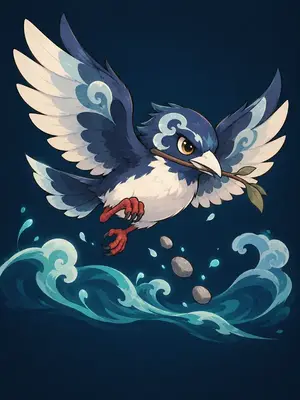 Jingwei 精卫A small crow-like bird with a patterned head, white beak and red feet, calling its own name as it carries stones to fill the sea.
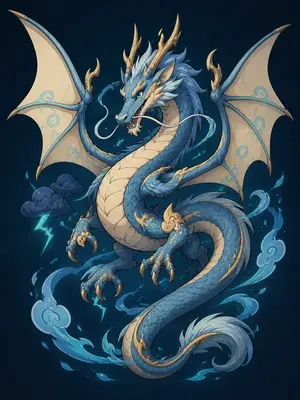 Yinglong 应龙A winged dragon that stores the rains. It killed Chiyou and Kuafu and now lives at the southern pole.
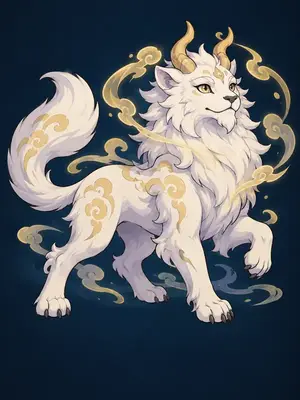 Bai Ze 白泽A talking beast that knows the nature of all things. Not in the Shan Hai Jing, but often counted among its creatures.
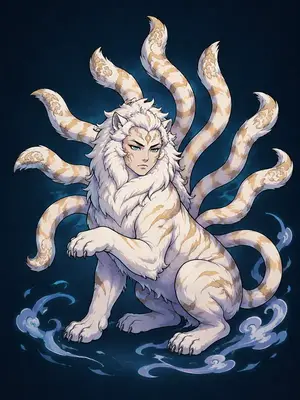 Lu Wu 陆吾A god with a tiger's body, nine tails, a human face and tiger claws, who guards Kunlun for the Heavenly Emperor.
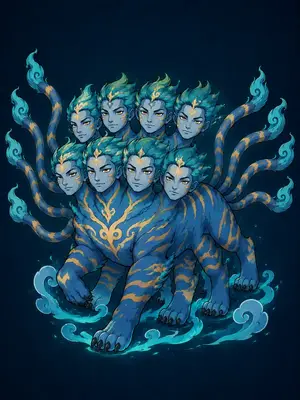 Tianwu 天吴A water god with eight human-faced heads, eight legs and eight tails, its back striped blue and yellow.