The Chinese Dragon: Meaning, Types and Legends
The long is a rain-bringing, shape-changing spirit of water, not a fire-breathing monster. Here is what the old books say about it, and how it became the emperor's emblem.
- Chinese name
- 龙 (lóng)
- Also known as
- Long, Loong
- Type
- Mythical creature
- First recorded
- Shang dynasty oracle bones, c. 1200 BCE
- Element
- Water: rivers, seas, clouds and rain
- Direction
- East (the Azure Dragon)
- Symbol of
- The emperor, power, good fortune and timely rain
What is the Chinese dragon?
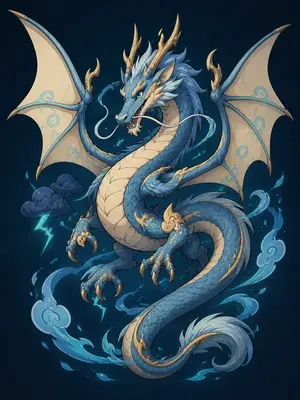
The Chinese dragon, called long in Chinese, is a long, scaled, usually wingless creature that lives in water and rises into the clouds to bring rain. It is the most important creature in Chinese mythology. Unlike the dragons of European legend, it is not a monster for heroes to slay. It is a powerful and mostly benevolent spirit that controls water, and for about two thousand years it was the emblem of the emperor.
The character for dragon already appears on Shang dynasty oracle bones, the divination records of around 1200 BCE, where the drawing shows a creature with a big head, an open mouth and a curling body. Dragon-like shapes made of shells or carved in jade are even older and come from Neolithic sites, though nobody knows what their makers called them. By the time China's first dictionary was compiled around 100 CE, the dragon had a full definition:
龍:鱗蟲之長。能幽,能明,能細,能巨,能短,能長;春分而登天,秋分而潛淵。
Long, the dragon: chief of the scaly creatures. It can be dark or bright, tiny or huge, short or long. At the spring equinox it climbs into the sky; at the autumn equinox it sinks into the deep.
Two ideas in this short entry run through everything that follows. The dragon can change its size and shape at will, and it follows the seasons: up into the sky in spring, when the rains are needed, and down into rivers and pools in autumn.
Chinese dragon meaning and symbolism
The core meaning of the dragon is water. In a farming country that lived or starved by the rains, the creature that controlled rivers, clouds and storms was the most powerful creature of all. People prayed to dragons for rain, built temples to local Dragon Kings beside rivers and springs, and blamed floods and droughts on dragons that were angry or absent.
The dragon also stands for transformation. The philosophical book Guanzi, compiled from texts of the Warring States period and later, describes it this way:
龍生於水,被五色而游,故神。欲小則化如蠶蠋,欲大則藏於天下,欲上則凌於雲氣,欲下則入於深泉。變化無日,上下無時,謂之神。
The dragon is born in water. Clad in the five colors, it swims about, and so it is divine. If it wants to be small, it becomes as small as a silkworm; if it wants to be large, it fills all under heaven. If it wants to rise, it rides above the clouds; if it wants to descend, it enters the deepest springs. Its changes keep no fixed day, its rising and sinking no fixed time: this is what we call divine.
The third meaning is greatness in a person. The Book of Changes, the old divination classic, uses the dragon in the lines of its very first hexagram, Qian, to describe stages of power and timing:
初九:潛龍勿用。九二:見龍在田,利見大人。
First line: a hidden dragon. Do not act. Second line: a dragon appears in the field. It is good to see the great man.
The same hexagram goes on to a flying dragon in the sky at the fifth line and an arrogant dragon who will have regrets at the top line. Confucian readers took these lines as a lesson about when a capable person should wait and when he should act. From here it was a short step to the dragon as the sign of the ruler, and later of anyone of outstanding talent. Parents in China still hope their son will become a dragon, and the dragon remains a general sign of good fortune, strength and success.
What does a Chinese dragon look like?
The familiar picture of the dragon, with antlers, a long snake-like body, fish scales and eagle claws, was assembled over many centuries. The Song dynasty scholar Luo Yuan, in his Erya Yi, a commentary on the names of plants and animals, quotes the Han writer Wang Fu on how people painted dragons and then gives the painters' rule of the nine resemblances:
角似鹿,頭似駝,眼似鬼,項似蛇,腹似蜃,鱗似魚,爪似鷹,掌似虎,耳似牛。
Horns like a deer, head like a camel, eyes like a demon, neck like a snake, belly like a clam monster, scales like a fish, claws like a hawk, palms like a tiger, ears like an ox.
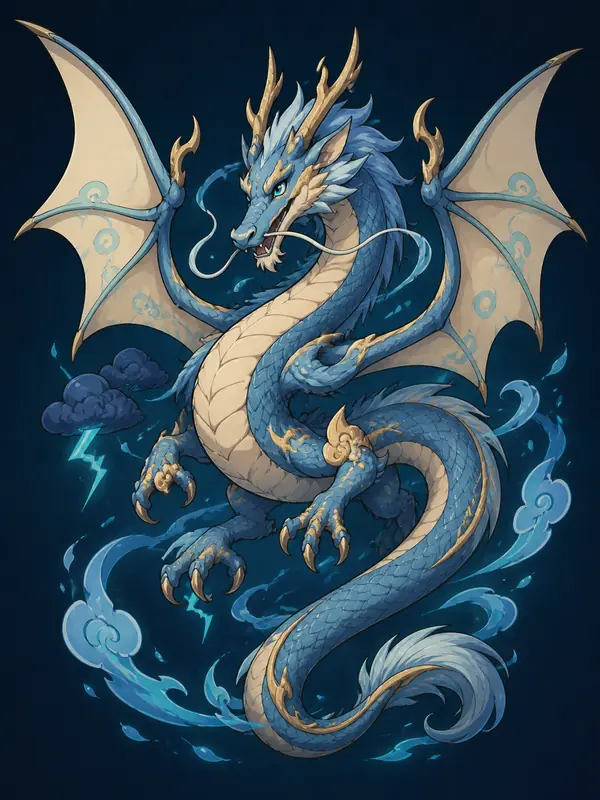
Luo Yuan adds that the dragon has a lump on its head called the chimu, and without it a dragon cannot rise to heaven. Some modern retellings change the demon's eyes to a rabbit's or a hare's; the edition we checked reads demon. Later art added the long whiskers, the flaming pearl that dragons chase through the clouds, and the flames along the legs. The number of claws changed too: early dragons often have three, and from the Yuan dynasty onward the five-clawed dragon became the imperial form.
Types of Chinese dragons
Chinese has many words for dragons and dragon-like creatures. Old texts do not always agree on what each one means, but these are the best established:
- Yinglong, the winged dragon. It stored the rains for the Yellow Emperor in his war against Chiyou. Its wings make it unusual among Chinese dragons.
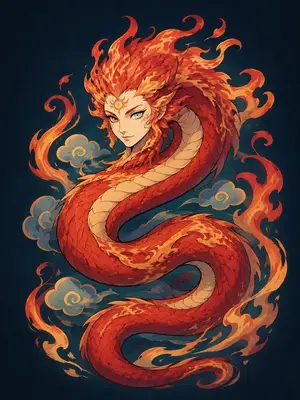
- Zhulong, the Torch Dragon. A red god with a human face and a serpent body in the far north, whose eyes make day and night.
- Jiao, a water dragon of rivers and lakes. Many texts treat it as a lesser dragon, sometimes hornless, and folk stories say a jiao that lives long enough may become a true dragon. Jiao were often blamed for floods.
- Qiu, usually described as a young dragon or a dragon with horns; old commentators disagree on which.
- Chi, a hornless dragon, very common as a decorative motif on jade, bronze and stone.
- Panlong, the coiled dragon, a dragon lying curled on earth that has not yet risen to the sky. It is often carved around pillars and on roof beams.
- The Azure Dragon of the East, one of the Four Symbols. It is the group of seven lunar mansions in the eastern sky, and stands for the east and spring.
- The Yellow Dragon, linked with the center and the earth in five-direction schemes. Han dynasty histories report sightings of yellow dragons as good omens.
You may also see lists of the celestial dragon, the spiritual dragon, the treasure dragon and so on. Those lists are modern groupings rather than categories from the old texts, and we have left them out.
The nine sons of the dragon
A well-known saying goes: the dragon has nine sons, and none of them is a dragon. Each son has its own nature and its own place on buildings and objects. The list of names was set down by Ming dynasty writers, roughly 500 years ago, and different authors give different sons. One common version runs:
- Qiuniu, who loves music, carved on the heads of stringed instruments.
- Yazi, who loves to fight, carved on sword hilts and blades.
- Chaofeng, who loves danger and high places, set on the corners of roofs.
- Pulao, who loves to roar, cast as the loop on top of bells.
- Suanni, a lion-like son who loves to sit and likes smoke, placed on incense burners.
- Bixi, a tortoise-like son who loves to carry heavy loads, carved under stone steles.
- Bi'an, a tiger-like son who loves lawsuits, carved over prison gates.
- Fuxi, who loves literature, coiled along the tops of steles.
- Chiwen, who loves to swallow, set at the ends of roof ridges to guard against fire.
Other versions swap in Taotie, the glutton whose face appears on ancient bronzes, Jiaotu, a shell-like son that guards doors as the door knocker, or Bafu, a water-loving son carved on bridges. The number nine was never really a count. In Chinese, nine is the largest single digit and often simply means many.
The Four Dragon Kings
In popular religion the waters of the world are ruled by Dragon Kings. The idea grew after Buddhism arrived from India and brought the naga kings, serpent rulers of the waters, which Chinese translators rendered as dragon kings. Over time every river, lake, well and spring could have its own Dragon King, and villages prayed at his temple for rain.
Above them stand the Dragon Kings of the Four Seas, who rule the eastern, southern, western and northern oceans that were thought to surround the land. The Ming novel Journey to the West gives them the names most people use today: Ao Guang of the Eastern Sea, Ao Qin of the Southern Sea, Ao Run of the Western Sea and Ao Shun of the Northern Sea. Each lives in an underwater crystal palace with shrimp soldiers and crab generals, and each answers to the Jade Emperor, who decides when and where rain may fall.
The Dragon King of the Eastern Sea is the best known, because Sun Wukong takes his famous iron staff from that palace in Journey to the West. In Investiture of the Gods, another Ming novel, the same Dragon King's son clashes with the boy god Nezha. In these novels the Dragon Kings are powerful but bureaucratic: officials of the sea, not gods to be feared.
Chinese dragon vs western dragon
The Chinese dragon and the dragon of European legend share an English word, but they are very different creatures:
- Element: the Chinese dragon belongs to water and brings rain; the western dragon is usually a creature of fire.
- Nature: the Chinese dragon is mostly benevolent and wise, though it can be dangerous when angry; the western dragon is usually a destroyer that hoards treasure.
- Body: the Chinese dragon is long and serpent-like with four short legs and usually no wings; the western dragon is heavy, often with bat-like wings.
- Flight: the Chinese dragon flies by its own power over clouds and weather, not by flapping wings.
- Role: in Chinese stories people pray to dragons; in European stories heroes kill them.
Because of these differences, some people now prefer to write the Chinese creature as loong, so that it is not confused with the western dragon. Both spellings are in use.
The Chinese dragon also spread across East Asia. Japanese, Korean and Vietnamese dragons all grew from it. A popular modern explanation says the number of claws tells them apart: Chinese imperial dragons have five, Korean dragons four and Japanese dragons three, sometimes with the story that a dragon loses claws the farther it travels from China. This is a later tradition rather than a fixed rule. Japanese art often does show three-clawed dragons, but old dragons in all these countries come with three, four or five claws.
The dragon and the emperor
The link between the dragon and the ruler is very old. The Records of the Grand Historian tells how, before Liu Bang founded the Han dynasty, his mother was resting beside a great marsh during a storm, and his father saw a jiao dragon over her. Stories like this made the dragon a sign of the right to rule. Emperors were said to be true dragons and Sons of Heaven, and the emperor's face, body and throne were described as the dragon face, the dragon body and the dragon seat.
Dragon imagery on clothes and objects was gradually reserved for the court. From the Yuan dynasty onward, rules limited the five-clawed dragon to the imperial family, while four-clawed dragon-like creatures, called mang or python, could be granted to high officials. The Ming and Qing courts kept this distinction: the emperor wore the dragon robe, usually in bright yellow, and officials who received the honor wore python robes. In practice the rules were often bent, and many dragons with five claws survive on objects made outside the palace.
The Forbidden City in Beijing is covered in dragons: on roofs, ceilings, thrones, stone carvings and the famous Nine Dragon Wall, built in the Qing dynasty.
Year of the Dragon, dragon dance and Dragon Boat Festival
The dragon is the fifth of the twelve animals of the Chinese zodiac, and the only one that is not a real animal. Recent dragon years were 1964, 1976, 1988, 2000, 2012 and 2024, and the next is 2036. Each zodiac year starts at the Lunar New Year, in late January or February, so someone born in January may belong to the previous animal. In popular belief people born in a dragon year are confident, ambitious and lucky, and many families have long considered it an especially good year to have a child.
The dragon dance is performed at the Lunar New Year, the Lantern Festival and other celebrations. A team of dancers holds a long cloth dragon up on poles and makes it twist and wave, often chasing a pearl carried by another dancer. The older purpose of the dance was to please the dragon and ask for good rain and harvests.
The Dragon Boat Festival falls on the fifth day of the fifth lunar month. Teams race long boats carved with a dragon's head and tail to the beat of a drum, and people eat zongzi, sticky rice wrapped in leaves. The best-known story ties the festival to the poet Qu Yuan, who drowned himself in a river; people raced out in boats to look for him and threw rice into the water so that the fish and dragons would leave his body alone. Luo Yuan's Erya Yi already notes that, since the Han dynasty, people making offerings to Qu Yuan had tied them up with chinaberry leaves and five-colored thread, because jiao dragons were said to fear both.
Dragons in the Shan Hai Jing and Beasts of Shanhai
The Shan Hai Jing, or Classic of Mountains and Seas, has no single dragon entry, but dragons and dragon-bodied gods appear throughout it. The most famous is Yinglong, the winged dragon of the Great Wilderness books:
大荒东北隅中,有山名曰凶犁土丘。应龙出南极,杀蚩尤与夸父,不得复上。故下数旱,旱而为应龙之状,乃得大雨。
In the northeast corner of the Great Wilds is a mountain called Xiongli Earth Hill. Yinglong dwells at the southern pole: it slew Chiyou and Kuafu and could not rise to heaven again. So the land below often suffers drought; in drought, people make Yinglong's likeness, and great rains come.
This is one of the earliest records of making a dragon image to call for rain, a practice that continued in China for many centuries. The second great dragon of the book is Zhulong, the Torch Dragon of the dark north:
有神,人面蛇身而赤,直目正乘,其瞑乃晦,其视乃明,不食不寝不息,风雨是谒。是烛九阴,是谓烛龙。
There is a god, red, with a human face on a snake's body and upright eyes. When it shuts its eyes the world goes dark; when it opens them it is light. It neither eats, sleeps nor breathes, and summons wind and rain. It lights the nine darks: this is the Torch Dragon.
Zhulong shows how loose the early idea of a dragon was: the text calls it a god with a snake's body, yet its name means torch dragon. Many mountain gods in the same book are also described as part dragon. Our Shan Hai Jing bestiary has both dragons with their full entries and original art.
Yinglong and Zhulong are both units in Beasts of Shanhai, our free browser auto battler set in the world of the Shan Hai Jing. Yinglong is a Water beast whose Rainstorm skill hits every foe at the start of a battle and weakens Fire beasts, from the stored waters of its war against Chiyou. Zhulong is a Fire beast that alternates every round between burning all foes and healing all allies, like day following night. They fight beside other creatures from the same books, among them the fenghuang, which the Book of Rites counts with the dragon and the qilin among the four spirit animals.
Questions
What does the Chinese dragon symbolize?
Above all, water and rain. It also stands for transformation, power and good fortune, and for about two thousand years it was the emblem of the emperor.
Is the Chinese dragon good or evil?
Mostly good. It brings rain and protects, and people pray to it. Dragons in stories can still be dangerous when angered, and jiao water dragons were often blamed for floods.
How is it pronounced?
The Chinese word for dragon is long, said with a rising tone, roughly like the English word long. Some people spell it loong.
Why does the Chinese dragon have no wings?
It flies by its own magic power, riding the clouds, so it does not need them. A few dragons do have wings, most famously Yinglong in the Shan Hai Jing.
How many claws does a Chinese dragon have?
Imperial dragons from the Yuan dynasty onward have five claws. Earlier dragons often have three or four, and the idea that the number of claws marks China, Korea and Japan is a later tradition.
What are the nine sons of the dragon?
Nine creatures, each with its own nature, said to be the dragon's sons, such as Bixi under steles and Chiwen on roof ridges. The list comes from Ming dynasty writers, and versions differ.
Is the Chinese dragon real?
No. It is a mythical creature. Some scholars think fossils, crocodiles, snakes and lightning all fed into the image, but this is speculation.
Related entries
- QilinCreatureA one-horned beast of perfect kindness that appears only under a wise ruler. One of the four spirit animals, and a bringer of sons.
- PixiuCreatureA winged lion-like beast said to swallow wealth and never let it go. In the oldest texts it was a fierce animal and a symbol of brave troops.
- Chinese Mythology CreaturesOverviewThe creatures of Chinese myth by group: dragons, the Four Symbols, the four spirit animals, the Four Perils, Shan Hai Jing beasts and folk monsters.
- Chinese GodsOverviewThe main Chinese gods by group: creators, sage kings, the Daoist heaven, Buddhist figures, gods of wealth and war, and the moon goddess Chang'e.