Sun Wukong, the Monkey King of Journey to the West
A monkey born from a stone who learned immortality, fought all of heaven, spent five hundred years under a mountain and walked to India to become a Buddha.
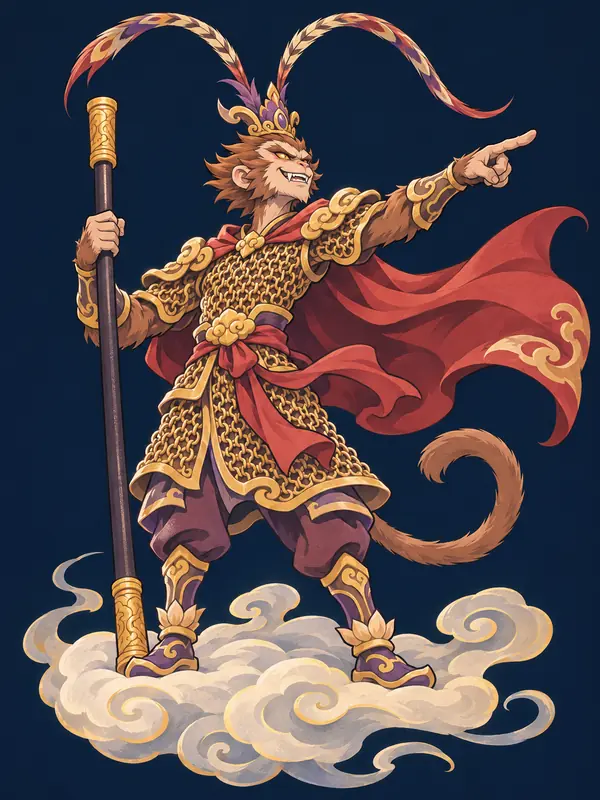
- Chinese name
- 孙悟空 (Sūn Wùkōng)
- Also known as
- Monkey King, Great Sage Equal to Heaven, Sun Xingzhe
- Type
- Hero of myth and fiction
- Main source
- Journey to the West, a 100-chapter Ming dynasty novel
- Born
- From a magic stone on the Mountain of Flowers and Fruit
- Weapon
- The Ruyi Jingu Bang, a staff of 13,500 jin
- Final title
- Victorious Fighting Buddha
Who is Sun Wukong?
Sun Wukong is the Monkey King, the hero of Journey to the West, the sixteenth century Chinese novel that is one of the most famous books in East Asia. He is a monkey born from a stone who teaches himself to become immortal, wrecks heaven when the gods refuse to take him seriously, is trapped under a mountain by the Buddha for five hundred years, and then earns his freedom by guarding the monk Tang Sanzang on the long walk to India to fetch Buddhist scriptures. At the end of the book he becomes a Buddha himself.
Journey to the West has 100 chapters. It is usually attributed to Wu Cheng'en, a Ming dynasty writer, although the book was first printed without an author's name and the attribution is still debated. The novel stands on a real event: the monk Xuanzang left China in the seventh century, traveled overland to India and came back years later with hundreds of Buddhist texts. Storytellers spent centuries turning that pilgrimage into a fantasy, and the monkey bodyguard became its star.
In the book Sun Wukong is clever, vain, loyal, impatient and very funny. He can be cruel, especially early on, and he never quite loses his habit of laughing at people with power. He is often the first figure people meet in Chinese mythology.
Born from a stone on the Mountain of Flowers and Fruit
The first chapter places the story on an island mountain in the sea off a country called Aolai, in the eastern continent of the world. It is the Mountain of Flowers and Fruit, and on its very top sits a stone that has soaked up the essence of heaven and earth since the world began.
那座山正當頂上,有一塊仙石。
On the very top of that mountain there was a magic stone.
The stone is 36 feet 5 inches tall in the old Chinese units, matching the 365 degrees of the heavenly circle, and 24 feet around, matching the 24 solar terms of the calendar. It has nine openings and eight holes, matching the nine palaces and the eight trigrams. One day the stone splits open and gives birth to a stone egg. The wind blows on the egg and it turns into a stone monkey, complete with all its limbs and senses.
The new monkey bows to the four directions, and two beams of golden light shoot from his eyes up to the palace of heaven. The Jade Emperor sends his officers Thousand-Mile Eye and Wind-Following Ear to look. They report that it is only a monkey born from a stone, and the Jade Emperor decides it is nothing to worry about.
Every name and title, in the order of the novel
Sun Wukong collects names the way other heroes collect wounds, and each one marks a turn in the story. In order:
- Stone Monkey: what he is called at birth, before he has any other name.
- Handsome Monkey King: he becomes king after leaping through a waterfall and finding the Water Curtain Cave behind it, a home for the whole tribe of monkeys.
- Sun Wukong: his teacher, the Patriarch Subodhi, gives him this as his name in religion. Sun means he has a surname at last; Wukong means "awakened to emptiness".
- Bimawen, Keeper of the Heavenly Horses: the lowly job heaven first gives him, a post with no rank at all.
- Great Sage Equal to Heaven: the title he gives himself in anger, which heaven later grants him to keep the peace.
- Sun Xingzhe, Pilgrim Sun: the nickname Tang Sanzang gives him when he joins the journey; xingzhe means a wandering monk.
- Victorious Fighting Buddha: the title the Buddha gives him in the last chapter.
The first title comes straight out of the waterfall episode. The monkeys had agreed that whoever could go through the falling water and come back unhurt would be their king. The stone monkey jumps, finds the cave, leads everyone inside, and the monkeys bow to him.
自此,石猿高登王位,將「石」字兒隱了,遂稱「美猴王」。
From then on the stone monkey sat high on the throne. He dropped the word "stone" and called himself the Handsome Monkey King.
His surname has a joke inside it. The Patriarch says he looks like a hu sun, an old word for a macaque. He first thinks of the surname Hu, then takes the animal part off the character for sun and is left with a character meaning boy child. That gives Sun, which also happens to be a common Chinese surname. The given name Wukong follows the generation character wu that the Patriarch's disciples share at that point in his line of twelve.
The title Great Sage Equal to Heaven comes later. When the monkey learns that Keeper of the Heavenly Horses is not even a ranked post, he smashes his way out of heaven and goes home. Two demon kings tell him a being with his powers should not be minding horses, and he has a banner made that reads Great Sage Equal to Heaven. Heaven finally agrees to the title because, as one official puts it, it can be an office with no salary and no duties.
Sun Wukong's powers
Sun Wukong's powers come in two batches: what he learns from his teacher, and what he takes from heaven. On the Mountain of the Mind, at the Cave of the Slanting Moon and Three Stars, the Patriarch Subodhi offers him either the thirty-six heavenly transformations or the seventy-two earthly ones. The monkey picks the larger number.
- Seventy-two transformations: he can turn into animals, people, objects and buildings, though his tail is hard to hide.
- The somersault cloud: one somersault carries him 108,000 li, tens of thousands of miles.
- Body outside the body: he pulls out a handful of hairs, chews them, blows them out and each turns into a copy of himself. The novel says he has 84,000 hairs and each can change.
- Fiery golden eyes: eyes that see through disguises, a gift he gets by accident in a furnace.
- Immortality, several times over: he learns long life from his teacher, crosses his own name out of the underworld's records, eats heaven's peaches of immortality and swallows Laozi's elixir pills.
The immortality comes in steps. In Chapter 3 two messengers of death drag his soul to the underworld. He beats them, storms the hall of the Ten Kings and demands the Register of Life and Death. He strikes out his own name and the names of every monkey he can find, and the novel adds that from then on many monkeys on his mountain never grew old. Later, set to guard the Peach Garden of heaven, he eats the ripest peaches of immortality himself. He then gatecrashes the banquet the Queen Mother of the West holds for those peaches, drinks the immortals' wine and wanders into the laboratory of Laozi, where he eats five gourds of golden elixir pills like roasted beans.
The fiery golden eyes come from punishment. When heaven cannot execute him, Laozi puts him in his eight-trigram furnace to burn him down into elixir. The monkey hides in the corner of the wind trigram, where there is wind but no fire. The smoke turns his eyes red, and when the furnace opens after forty-nine days he jumps out with eyes that can see through any disguise.
Sun Wukong's staff from the Dragon King's palace
Sun Wukong's staff is the Ruyi Jingu Bang, the as-you-will gold-banded staff. In Chapter 3 the monkey goes looking for a weapon and dives under the sea to the crystal palace of Ao Guang, the Dragon King of the Eastern Sea. Every sword and halberd the dragons offer is too light. Then the Dragon King's wife mentions the iron pillar in their treasury, which has been glowing for days.
In the novel the pillar is a piece of divine iron that Yu the Great used to fix the depth of the rivers and seas when he tamed the great flood. Later retellings often call it the needle that calms the sea. When the monkey picks it up, it shrinks and grows on command. It is black iron with a gold band at each end, and next to the band is an inscription.
如意金箍棒,重一萬三千五百斤。
The As-You-Will Gold-Banded Staff. Weight: thirteen thousand five hundred jin.
A jin is a traditional Chinese weight of a little over a pound, so the staff weighs several tons. Sun Wukong carries it shrunk to the size of an embroidery needle and tucked inside his ear. Before he leaves the sea he also bullies the other Dragon Kings of the four seas into giving him a full suit of armor. The dragons complain to the Jade Emperor, and so do the Ten Kings of the underworld.
Havoc in heaven and five hundred years under the mountain
Havoc in heaven is the name for Chapters 4 to 7, when Sun Wukong fights the whole celestial court. The gods first try to buy him off with a job, then with a title. When he learns he has not been invited to the peach banquet, he eats the peaches, drinks the wine, steals Laozi's pills and goes home to throw a party. Heaven sends an army of a hundred thousand soldiers against the Mountain of Flowers and Fruit and cannot beat him. Only the god Erlang, with help from Laozi, finally captures him.
Execution does not work: blades bounce off him, thunder does not hurt him, and the furnace only gives him better eyes. In the end the Jade Emperor asks the Buddha for help. The Buddha makes a wager: if the monkey can jump out of his palm, he can have the throne of heaven. Sun Wukong somersaults to five pink pillars at what he thinks is the end of the world, writes his name on one, urinates at its base and flies back. The Buddha shows him his own hand. The words are written on his middle finger.
將五指化作金、木、水、火、土五座聯山,喚名「五行山」,輕輕的把他壓住。
He turned his five fingers into a chain of five mountains, Metal, Wood, Water, Fire and Earth, called it the Mountain of the Five Elements, and gently pressed the monkey down beneath it.
The monkey stays under the mountain, eating iron pellets when he is hungry and drinking molten copper when he is thirsty, guarded by local earth spirits. In Chapter 14 he tells Tang Sanzang that he is the Great Sage who made havoc in heaven five hundred years before. By then the mountain has a new name, the Mountain of Two Frontiers. The five elements that hold him down are the same five elements of metal, wood, water, fire and earth that run through older Chinese myth, including the beasts of our free game Beasts of Shanhai.
The journey west with Tang Sanzang
The journey west begins when the bodhisattva Guanyin, looking for a pilgrim to fetch scriptures from India, stops at the mountain. The monkey promises to protect the pilgrim if she will set him free. In Chapter 14 the monk Tang Sanzang, based on the historical Xuanzang, peels the Buddha's seal of six gold characters off the top of the mountain and Sun Wukong bursts out. He becomes the monk's first disciple and gets the name Pilgrim Sun.
He does not stay obedient for long. On the first day he kills a band of robbers, the monk scolds him, and he storms off. Guanyin, disguised as an old woman, gives the monk a cap with a gold band inside it and a spell to go with it. When the monkey returns and puts the cap on, the monk recites the spell and the band tightens until Sun Wukong rolls on the ground with a splitting headache. The band takes root on his head and cannot be pulled off. The spell is called the Spell for Fixing the Mind, also known as the tight-band spell.
Three more companions join along the road: Zhu Bajie, called Pigsy in many translations, a greedy and lazy fallen marshal of heaven reborn as a pig; Sha Wujing, called Sandy, a quiet former general of heaven turned river monster; and the Dragon Prince who becomes the monk's white horse. Most of the novel is a chain of adventures. Demons want to eat the monk, because his flesh is said to give eternal life, and Sun Wukong has to find out which demon it is, where it came from and which god in heaven it escaped from. The book counts eighty-one ordeals in all, and the journey takes fourteen years.
Is Sun Wukong a god?
In the novel, Sun Wukong ends as a Buddha. In the last chapter the pilgrims bring the scriptures back to the Tang capital and are carried up to the Buddha's paradise, where each receives a reward. The Buddha recalls the monkey's crimes and then his service.
全終全始,加陞大職正果,汝為鬥戰勝佛。
You kept faith from the beginning to the end, so I raise you to a great office and the true fruit: you are the Victorious Fighting Buddha.
Right after this, the monkey asks his master to recite a spell to loosen the gold band so he can smash it. The monk answers that now he is a Buddha the band has gone of its own accord, and when Sun Wukong feels his head it is no longer there.
Outside the novel, many people do worship him. As the Great Sage Equal to Heaven he has temples in southeast China, Taiwan, Hong Kong and Southeast Asia, where people pray to him for protection and courage. In folk religion he is a protective god, even though his story started in a novel.
Where did Sun Wukong come from?
Where Sun Wukong came from before the novel is an open question. The earliest surviving version of the monkey is in a short text usually dated to the Song dynasty, The Story of How Tripitaka of the Great Tang Fetched the Scriptures, where a monkey pilgrim, appearing as a scholar in white, joins the monk and guides him with magic. So the monkey was already part of the story centuries before the Ming novel.
Behind that, scholars disagree. Some have argued that he grew out of Hanuman, the monkey hero of the Indian epic Ramayana, who also flies, changes size and serves a divine master; the scholar Hu Shi was an early voice for this view. Others have argued for a Chinese origin in Wuzhiqi, a monkey-like water spirit of the Huai River whom Yu the Great is said to have chained beneath a mountain, a view put forward by the writer Lu Xun. Others think he drew on both. None of these theories has settled the question.
Sun Wukong today
Sun Wukong is probably the most retold figure in Chinese myth. His story has been adapted into opera, puppet theater, comics, cartoons, films and television in China and far beyond. Well-known examples include the 1960s animated film Havoc in Heaven and the 1986 television series Journey to the West, and the hero of the manga Dragon Ball takes his name from the Japanese reading of Sun Wukong.
To go back to the source, read the first seven chapters of the novel, which tell the Monkey King's story on his own. For the dragons he bullies, see our entry on the Chinese dragon, and for the court he fights, see the gods of Chinese mythology.
Questions
Who is Sun Wukong?
Sun Wukong is the Monkey King, the hero of the Ming dynasty novel Journey to the West. He is a monkey born from a stone who becomes immortal, rebels against heaven, is trapped by the Buddha and then protects the monk Tang Sanzang on his journey to India.
How do you pronounce Sun Wukong?
Roughly "soon woo-kong". Sun rhymes with the English word soon, and the second word is said woo-kong.
What does the name Wukong mean?
Wukong means "awakened to emptiness", a Buddhist idea. His teacher gave him the name, and the surname Sun comes from a pun on an old word for monkey.
Is Sun Wukong good or evil?
Both, at different points. He starts as a proud troublemaker who wrecks heaven, then spends the journey protecting his master and ends as a Buddha. Most readers see him as a hero with a bad temper.
How strong is Sun Wukong's staff?
The inscription on it says it weighs 13,500 jin, several tons. It can shrink to the size of a needle or grow huge, and the monkey keeps it in his ear.
Is Sun Wukong a god?
In the novel he becomes the Victorious Fighting Buddha. In folk religion he is also worshipped as the Great Sage Equal to Heaven, and he has temples in China and Southeast Asia.
Is Sun Wukong based on Hanuman?
Some scholars think so, pointing to the Indian monkey hero of the Ramayana. Others argue for a Chinese origin in the water spirit Wuzhiqi. The question has not been settled.
Related entries
- Chinese GodsOverviewThe main Chinese gods by group: creators, sage kings, the Daoist heaven, Buddhist figures, gods of wealth and war, and the moon goddess Chang'e.
- Chinese DragonCreatureThe long: a scaled spirit of water and rain that can shrink or grow at will, chief of all scaly creatures and the emblem of the emperor.