Taotie, the Glutton of Chinese Mythology
Taotie is the monster of endless greed: a man-eating beast in the Shan Hai Jing, one of the Four Perils of ancient China, and the staring face on Shang dynasty bronzes.
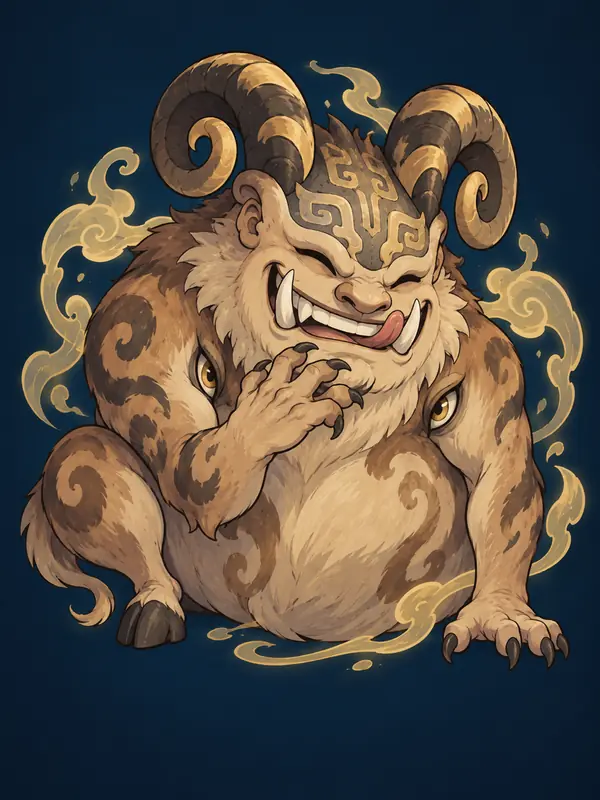
- Chinese name
- 饕餮 (tāotiè)
- Oldest source
- Shan Hai Jing, Northern Mountains, Book 2
- Where it lives
- Mount Gouwu
- In the game
- Earth beast · 4 Gold · Gluttony
What the Shan Hai Jing says
The Shan Hai Jing never uses the name taotie. In the second book of the Northern Mountains it describes a beast on Mount Gouwu called the Paoxiao: a goat's body with a human face, eyes under its armpits, tiger teeth and human nails, and, like several man-eaters in the book, a cry like a baby's.
有兽焉,其状如羊身人面,其目在腋下,虎齿人爪,其音如婴儿,名曰狍鸮,是食人。(郭璞注:为物贪惏,食人未尽,还害其身,像在夏鼎,《左传》所谓饕餮是也。)
A beast lives here, with a goat's body and human face, eyes under its armpits, tiger teeth and human nails, crying like a baby. It is called the Paoxiao and eats people. (Guo Pu's note: so greedy it eats people and, not yet full, harms itself. It is cast on the Xia cauldrons: the Taotie of the Zuo Zhuan.)
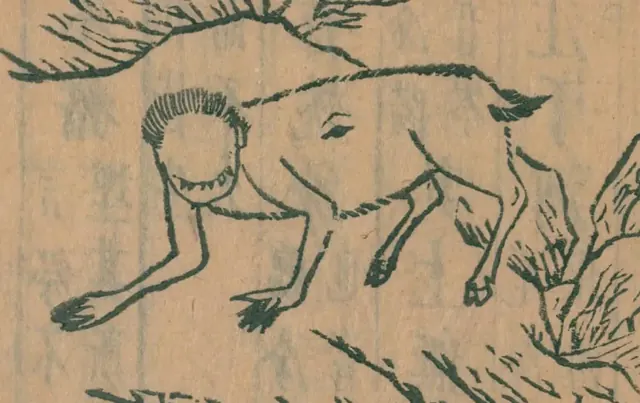
The link to taotie comes from Guo Pu, the 4th-century scholar whose notes are printed with the book. He wrote that the Paoxiao is so greedy that it eats people and, still not full, turns on its own body, and that this is the creature cast on the ancient cauldrons, the one the Zuo Zhuan calls taotie.
One of the Four Perils
In the Zuo Zhuan, an ancient history, taotie is the nickname people gave to a worthless son of the Jinyun clan who was greedy for food and drink and grabbed wealth without limit. He is one of the Four Perils, four villains that the sage king Shun drove out to the edges of the world. The other three are Hundun, Qiongqi and Taowu.
The taotie on ancient bronzes
Taotie is also the name of a famous design: a symmetrical monster face with large eyes and horns, cast on bronze vessels of the Shang and Western Zhou dynasties more than 3,000 years ago. The Lüshi Chunqiu, a text from the 3rd century BC, says the Zhou cauldrons carried a taotie with a head but no body, eating people but unable to swallow, so that the harm came back on itself.
Scholars from the Song dynasty onward called the bronze motif a taotie mask, and the name stuck, although nobody knows what the original makers called it.
Taotie, the Glutton in Beasts of Shanhai
In our free browser game Beasts of Shanhai, Taotie, the Glutton is a Earth beast that costs 4 Gold. Its skill is Gluttony. Whenever any beast dies, Taotie eats it first: that beast's Last Breath does not trigger, and Taotie heals and gains max HP equal to 25% of the beast it ate. It eats 2 beasts per battle at one star and 4 at three stars.
Questions
What does taotie mean?
Taotie is usually translated as "glutton". In ancient Chinese texts the word describes a person or creature with endless greed for food and wealth.
Is taotie in the Shan Hai Jing?
Not by that name. The Shan Hai Jing describes the Paoxiao of Mount Gouwu, and the commentator Guo Pu identified it as the taotie.
Why does the taotie have no body?
The Lüshi Chunqiu describes the taotie on Zhou cauldrons as a head with no body, eating people but unable to swallow them: a warning that greed harms the greedy.
More creatures
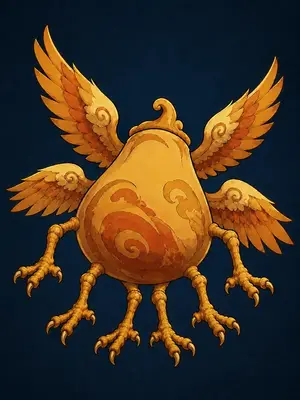 Hundun 混沌A faceless god like a red sack, with six legs and four wings. It has no eyes, yet it knows song and dance.
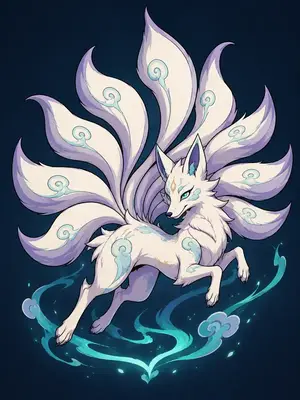 Nine-Tailed Fox 九尾狐A fox with nine tails and a cry like a baby's. It eats people, and eating it keeps curses away.
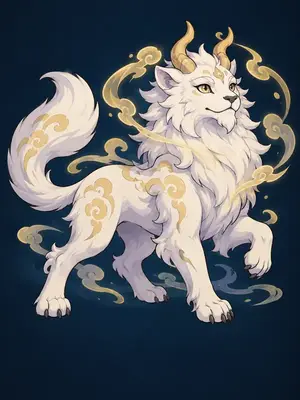 Bai Ze 白泽A talking beast that knows the nature of all things. Not in the Shan Hai Jing, but often counted among its creatures.
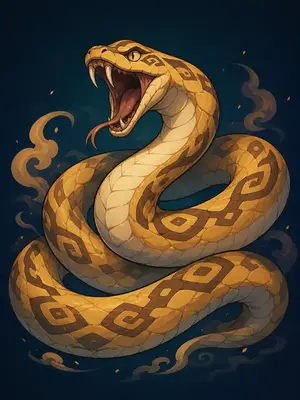 Bashe 巴蛇A huge snake of blue, yellow, red and black that swallows elephants and spits out the bones after three years.
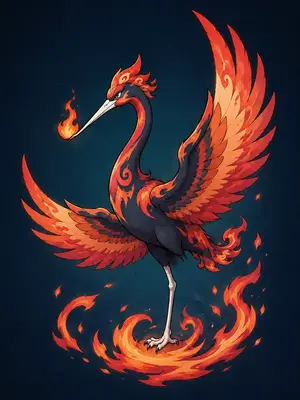 Bifang 毕方A one-legged crane with red markings on blue and a white beak. Where it appears, strange fires break out.
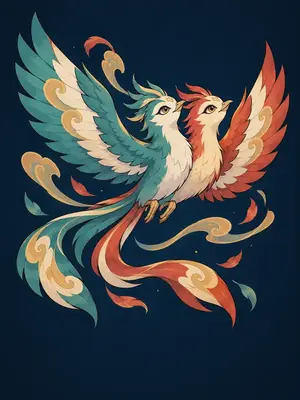 Biyi Bird 比翼鸟Two birds, one green and one red, flying wing to wing. Later poets made them a symbol of inseparable love.