Hundun, the Faceless Chaos of Chinese Mythology
Hundun means chaos: a faceless god who dances in the Shan Hai Jing, an emperor who dies when he is given a face in the Zhuangzi, and one of the Four Perils.
- Chinese name
- 混沌 (hùndùn)
- Oldest source
- Shan Hai Jing, Western Mountains, Book 3
- Where it lives
- Mount Tian
- In the game
- Earth beast · 3 Gold · Silence
What the Shan Hai Jing says
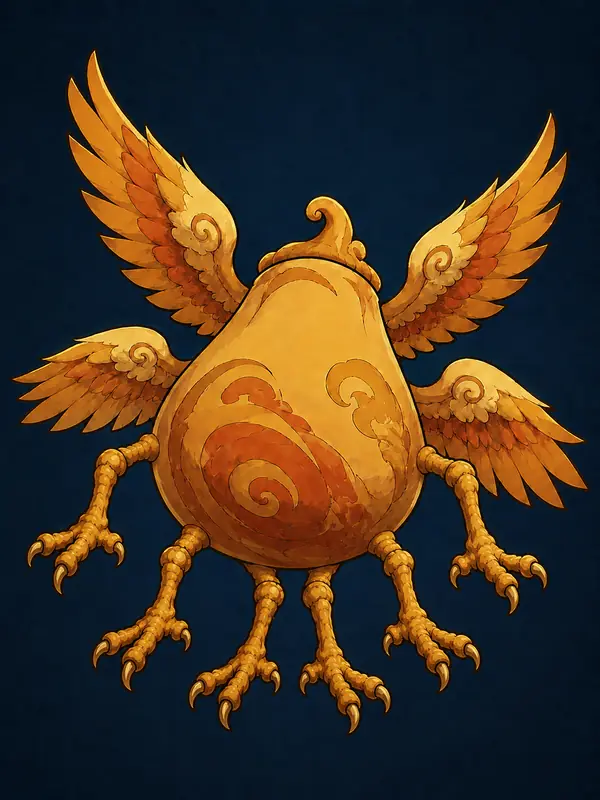
In the third book of the Western Mountains, the Shan Hai Jing reaches Mount Tian, the Heavenly Mountain, and describes the god that lives there: shaped like a sack, red as cinnabar fire, with six legs and four wings.
有神焉,其状如黄囊,赤如丹火,六足四翼,浑敦无面目,是识歌舞,实为帝江也。
A god lives here, shaped like a yellow sack, red as cinnabar fire, with six legs and four wings. It is a faceless blur, yet it knows song and dance. It is Dijiang.
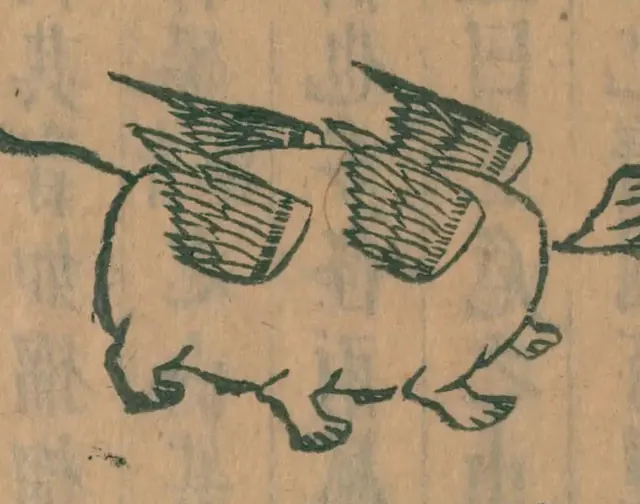
The key word is hundun: the god is a formless blur with no face and no eyes, yet it understands song and dance. The book names it Dijiang, and because of this line Dijiang and Hundun are often treated as the same being.
The emperor without a face
The best-known Hundun story is in the Zhuangzi, a Daoist classic. Hundun, the emperor of the center, treated Shu and Hu, the emperors of the southern and northern seas, very kindly. To repay him, they decided to give him the seven openings every person has for seeing, hearing, eating and breathing. They bored one hole a day, and on the seventh day Hundun died.
The story is usually read as a warning against forcing order on what is natural.
One of the Four Perils
The Zuo Zhuan uses Hundun as the nickname of a worthless son of the Dihong clan who hid wrongdoers and kept company with the wicked. Together with Taotie, Qiongqi and Taowu, he is one of the Four Perils that the sage king Shun banished.
Hundun as primordial chaos
In later Chinese thought, hundun also names the shapeless state of the universe before heaven and earth separated: the chaos from which the world was born.
Faceless One (Dijiang) in Beasts of Shanhai
In our free browser game Beasts of Shanhai, Faceless One (Dijiang) is a Earth beast that costs 3 Gold. Its skill is Silence. At the start of a battle the strongest foe loses its skill for the whole battle. At two stars it also takes 2 attack from its target, and at three stars it silences the top 2 foes.
Questions
What does hundun mean?
Hundun means chaos: a shapeless mass with no openings or features. It names a faceless creature in myth and the formless state of the universe before creation.
Is Hundun the same as Dijiang?
They are closely linked. The Shan Hai Jing calls the faceless god of Mount Tian Dijiang and describes it with the word hundun, so many readers treat them as one.
Why did Hundun die?
In the Zhuangzi, two grateful emperors bored seven openings into Hundun's faceless head, one a day, to give it senses. On the seventh day Hundun died.
More creatures
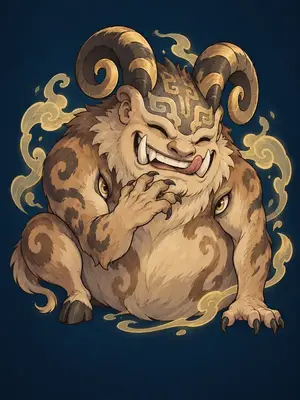 Taotie 饕餮A goat-bodied beast with a human face and eyes under its arms, so greedy it eats itself.
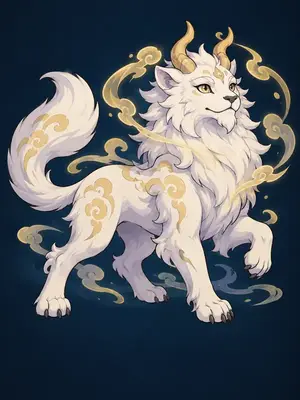 Bai Ze 白泽A talking beast that knows the nature of all things. Not in the Shan Hai Jing, but often counted among its creatures.
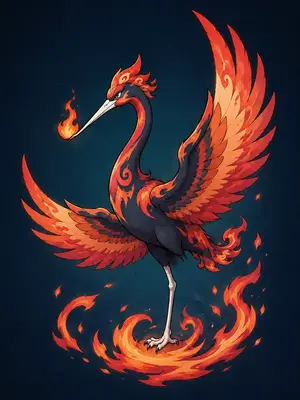 Bifang 毕方A one-legged crane with red markings on blue and a white beak. Where it appears, strange fires break out.
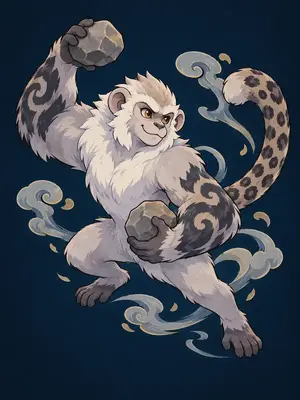 Jufu 举父An ape-like beast with striped arms, as fierce as a leopard or tiger, famous for throwing things with great skill.
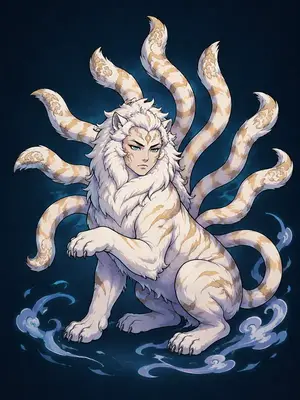 Lu Wu 陆吾A god with a tiger's body, nine tails, a human face and tiger claws, who guards Kunlun for the Heavenly Emperor.
 Qinyuan 钦原A bird shaped like a bee and as big as a mandarin duck. Its sting kills birds and beasts and withers trees.