The Qilin: Meaning, Appearance and Legends
The qilin is the gentle beast that appears only in good times: a one-horned deer in the oldest books, a scaled, dragon-headed guardian in later art.
- Chinese name
- 麒麟 (qílín)
- Also known as
- Kirin, Kylin, Girin
- Type
- Mythical creature, one of the four spirit animals
- First recorded
- Book of Songs, Zhou dynasty
- Appearance
- Deer body, ox tail, horse hooves and one horn; later a dragon head and scales
- Symbol of
- Benevolence, a wise ruler, peace, and the birth of gifted sons
- Not to be confused with
- The pixiu, which guards wealth
What is a qilin?
The qilin is a gentle, hooved beast of Chinese mythology with a single horn, often called the Chinese unicorn. It is one of the four spirit animals of ancient China, together with the dragon, the phoenix and the tortoise. The qilin is famous for its kindness: tradition says it will not harm any living thing, and it appears only when a wise and good ruler is on the throne. Seeing one was the best omen a kingdom could hope for.
The name is two characters. In early texts qi and lin are sometimes explained as the male and female of the same animal, while lin on its own is the older and more common name. The oldest dictionaries describe it like this:
麐:麕身,牛尾,一角。
Lin: the body of a river deer, the tail of an ox, one horn.
麒:仁獸也。麋身牛尾,一角。
Qi: the benevolent beast. The body of a deer, the tail of an ox, one horn.
The Shuowen Jiezi goes on to define the next character, lin, as the female qi. So the earliest qilin is a deer-like animal, not a dragon at all. It is benevolent before it is magical.
Qilin meaning: the benevolent beast
The qilin's meaning is benevolence, ren, the central virtue of Confucian thought. The Gongyang Commentary on the Spring and Autumn Annals puts it plainly:
麟者仁獸也。有王者則至,無王者則不至。
The lin is the benevolent beast. When there is a true king it comes; when there is no true king it does not come.
Later texts fill in what this kindness looks like. The Book of Song, a fifth-century history quoted further down this page, says the qilin does not tread on living insects or break living grass. Folk belief adds that it will not eat any living creature and that its horn is tipped with flesh, so that even its weapon cannot wound. These details come from later writers rather than from the oldest texts, but they explain why the qilin became a symbol of peace and good government.
Because the qilin comes only under a good ruler, its arrival was treated as heaven's approval. Court histories record qilin sightings as auspicious signs, and an emperor's officials had every reason to report them.
Qilin sightings in Chinese history
Because a qilin meant heaven approved of the ruler, reports of one carried real political weight. The best-known case comes from the Han dynasty. In 122 BCE Emperor Wu of Han is recorded as catching a white lin during a sacrificial hunt, and the event was celebrated as a great omen. The new reign period that followed was named Yuanshou, which can be read as the first hunt, in memory of it.
A later Han emperor, Emperor Xuan, built the Qilin Pavilion in his palace and had portraits of eleven officials who had served the dynasty well painted on its walls. To be painted in the Qilin Pavilion became a set phrase for the highest honor a minister could earn, and poets used it for centuries afterwards.
Sightings went on being reported in later dynasties, usually when a court wanted to show that its rule was blessed. Historians today read these records as evidence of what people believed and hoped for, not as sightings of an actual animal. Whatever creature was actually seen, the record itself was the point: a qilin in the annals told readers that the age was a good one.
This also explains why the capture of a qilin could be such bad news. If the beast came in an age without a sage king and was then caught by an ordinary hunter, the omen was turned upside down. That is exactly how the oldest commentaries read the most famous qilin story of all, the one connected with Confucius, described below.
Qilin appearance: from deer to dragon
The qilin's appearance changed a great deal over two thousand years. In the oldest texts it is a deer or river deer with an ox's tail and one horn. The Book of Songs, the earliest collection of Chinese poetry, praises its hooves, its forehead and its horn:
麟之趾,振振公子,于嗟麟兮。
The hooves of the lin: noble are the sons of the duke. Ah, the lin!
The poem compares the lords' sons to the qilin's hooves, which do not trample, and it is the earliest link between the qilin and fine sons.
By the fifth century the official histories describe a more composite beast. The Book of Song, the history of the Liu Song dynasty compiled by Shen Yue, opens its list of good omens with the qilin:
麕身而牛尾,狼項而一角,黃色而馬足。含仁而戴義,音中鍾呂,步中規矩,不踐生蟲,不折生草。
The body of a river deer and the tail of an ox, the neck of a wolf and a single horn, yellow in color with the hooves of a horse. It holds benevolence within and wears righteousness above; its cry matches the bells and pitch-pipes, its steps follow the compass and the square; it does not tread on living insects or break living grass.
Notice the horse's hooves and the yellow color. From here on the qilin is a solid-hooved, golden beast rather than a plain deer, and that is the starting point for the later artists.
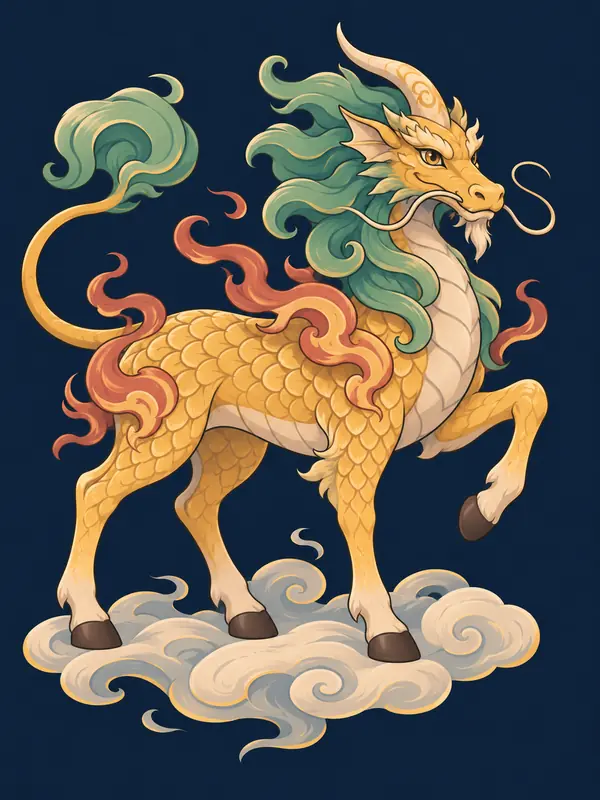
Over the following centuries the image grew more elaborate. Artists gave the qilin a dragon-like head, a body covered in fish scales, flames rising from its legs and shoulders, a flowing mane and a bushy tail. Many later qilin have two horns or a branched horn instead of one. By the Ming and Qing dynasties the typical qilin was a scaled, hooved creature with a dragon's face, which is the form you see on temple roofs and in New Year pictures today.
The qilin and the four spirit animals
The Book of Rites, a Confucian collection of ritual texts, groups the qilin with three other creatures as the four spirits:
何謂四靈?麟、鳳、龜、龍,謂之四靈。
What are the four spirits? The lin, the phoenix, the tortoise and the dragon: these are called the four spirits.
The same chapter explains that each spirit leads its kind. When the dragon is tamed, fish do not flee; when the phoenix is tamed, birds do not scatter; when the qilin is tamed, beasts do not run wild. The qilin is therefore the chief of all furred animals, as the Chinese dragon is chief of scaly creatures and the phoenix chief of birds. You can read the phoenix's own entry in the Shan Hai Jing on our fenghuang page.
These four spirits are not the same as the Four Symbols of the sky, the Azure Dragon, Vermilion Bird, White Tiger and Black Tortoise. Some later systems put the qilin at the center of the Four Symbols as a fifth animal, but that is a later arrangement.
The qilin and Confucius
The most famous qilin story concerns Confucius, and two very different kinds of source tell it. The first is history. The Spring and Autumn Annals, the court chronicle of the state of Lu, records in its entry for 481 BCE:
十有四年春,西狩獲麟。
Fourteenth year, spring: in a hunt in the west, a lin was caught.
The Gongyang Commentary explains why this was recorded. A gatherer of firewood had caught a strange horned animal. When Confucius heard of it he wept, wiped his face with his sleeve and asked who it had come for. Then he said that his way had come to an end. A benevolent beast had appeared in an age without a true king, and it had been hunted down and caught. The Gongyang and Guliang versions of the Annals stop at this entry, which is why the capture of the lin came to mark the end of the book and, for later readers, the end of Confucius's hopes.
The second story is legend. Later tradition says that before Confucius was born, a qilin appeared to his mother and spat out a jade tablet foretelling that her son would be a king without a throne. This tale of the qilin spitting out a jade book is not in the Annals or the early commentaries; it was told centuries later. Together the two stories frame Confucius's life with a qilin at the start and a qilin at the end.
Qilin vs kirin
Kirin is simply the Japanese reading of the same two characters, and girin is the Korean reading. The creature spread from China to Japan and Korea with Chinese books and art, and it kept its meaning as a gentle, auspicious beast that appears in peaceful times.
The main difference is in how it is drawn. Japanese kirin are often slimmer and more deer-like or horse-like, with a single horn and sometimes a flowing mane, while Chinese qilin after the Ming dynasty are usually stockier and more dragon-like, with scales and flames. In Japan the name is also familiar from a major beer brand, whose label shows the creature. Kylin is an older English spelling of the Chinese name.
Qilin vs dragon
People often search for a qilin dragon because later qilin really do look like dragons. A Ming or Qing qilin has a dragon's head, whiskers, scales and flames, and some popular sources even call it the child of a dragon. The two are still separate creatures. The dragon is the chief of scaly animals and belongs to water; the qilin is the chief of furred animals and walks on hooves on land. The dragon stands for power and the ruler; the qilin stands for benevolence and the good government that earns heaven's favor.
The resemblance grew because artists borrowed from the dragon to make the qilin look more imposing and more clearly divine. The pixiu, another hooved guardian with a dragon-like head, is often confused with the qilin too. In popular belief the pixiu draws in wealth, while the qilin brings peace and sons.
The qilin and the giraffe
In 1414, early in the Ming dynasty, envoys from Bengal brought a giraffe to the court of the Yongle Emperor. The voyages led by the admiral Zheng He had opened contact with the kingdoms of the Indian Ocean, and the animal came to China in connection with those fleets. Court officials presented it as a qilin: it was tall, gentle, hooved and ate only plants, and its Somali name sounded somewhat like qilin. A painting of the animal with a poem praising it as a qilin survives. Another giraffe arrived soon afterwards from the coast of East Africa.
The connection lasted. In Japanese and Korean the everyday word for giraffe is still kirin and girin, written with the same characters as the mythical beast. In Chinese, the giraffe is called by a different name.
The qilin bringing sons, in art and today
From the Book of Songs onward the qilin was tied to fine sons, and in folk belief this became a picture of the qilin bringing a child. New Year prints and embroidery show a small boy riding on a qilin, often holding a lotus or a sheng, a reed instrument, as a wish for a son who will grow up gifted and successful. Such pictures were hung in the homes of newly married couples. A talented child is still sometimes praised as a qilin child.
Pairs of stone qilin stand at the tombs of emperors and nobles, and qilin figures appear on temple roofs, gates and furniture. In the Qing dynasty the qilin was the badge of the highest rank of military officials, sewn on the front of their court robes. At Lunar New Year some communities, especially Hakka communities in southern China, perform a qilin dance similar to the lion dance.
The qilin is not one of the twelve animals of the Chinese zodiac. The dragon is the only mythical animal in the zodiac. In feng shui, qilin figures are placed to protect a home and bring peace, while the Chinese dragon and the pixiu have their own roles. You can find more creatures like it in our creatures entry and our Shan Hai Jing bestiary. The qilin is not in the Shan Hai Jing itself, which is why it does not appear as a unit in Beasts of Shanhai.
Questions
What is a qilin?
A gentle, one-horned beast of Chinese mythology, one of the four spirit animals. The oldest texts give it a deer's body, an ox's tail and one horn, and say it appears only under a wise ruler.
How do you pronounce qilin?
Roughly chee-lin, with both syllables rising in tone.
Is the qilin good or evil?
Good. It is called the benevolent beast, and tradition says it will not even step on living grass or insects.
Is a qilin a unicorn?
It is often called the Chinese unicorn because the oldest texts give it one horn, but it is a separate creature with its own history. Later qilin often have two horns.
What is the difference between a qilin and a kirin?
They are the same creature: kirin is the Japanese reading of the name. Japanese art tends to draw it slimmer and more deer-like.
Is the qilin a zodiac animal?
No. The twelve zodiac animals do not include the qilin; the dragon is the only mythical animal among them.
Is the qilin real?
No, it is a mythical animal. In 1414 a giraffe brought to the Ming court was presented as a qilin, and the Japanese and Korean words for giraffe still come from it.
Related entries
- Chinese DragonCreatureThe long: a scaled spirit of water and rain that can shrink or grow at will, chief of all scaly creatures and the emblem of the emperor.
- PixiuCreatureA winged lion-like beast said to swallow wealth and never let it go. In the oldest texts it was a fierce animal and a symbol of brave troops.
- Chinese Mythology CreaturesOverviewThe creatures of Chinese myth by group: dragons, the Four Symbols, the four spirit animals, the Four Perils, Shan Hai Jing beasts and folk monsters.