The Nian Monster: the Beast of Chinese New Year
Everyone knows the tale: a beast called Nian came every New Year's Eve until people learned it feared red, fire and noise. The old books tell an older story, with a different creature in it.
- Chinese name
- 年兽 (nián shòu)
- Also known as
- Nian Shou, Nian beast, Year beast, Chinese New Year monster
- Type
- Legendary beast of modern folk tradition
- Appears
- On New Year's Eve, from the mountains or the sea
- Fears
- The color red, firelight and loud noise
- Earliest known mention
- A Shanghai newspaper column, January 1933
- Older counterpart
- The shansao, a mountain imp driven off with exploding bamboo
- Name means
- Year; originally a ripe harvest
What is the Nian monster?
The Nian monster is the beast at the center of the best-known story about Chinese New Year. In the tale told today, a fierce creature called Nian came out of the mountains or the sea on the last night of every year to eat livestock and people, until villagers found that it was afraid of three things: the color red, firelight and loud noise. That, the story says, is why people paste red paper on their doors, light lanterns and set off firecrackers at the New Year.
The name is the ordinary Chinese word for year, pronounced roughly "nyen". In Chinese the creature is called nian shou, the year beast, so English writers use Nian monster, Nian beast and Chinese New Year monster for the same thing.
What most retellings leave out is that the story is not ancient. No early Chinese book mentions a beast called Nian, and the earliest written trace found so far dates from 1933. The customs are old, though, and the old books give them a different enemy: a small mountain demon that could not stand the bang of burning bamboo. This entry tells the modern legend first, then goes back to the texts.
The legend of Nian as it is told today
There is no single author and no fixed text, so the legend of Nian changes from teller to teller. The core runs like this. Long ago a beast named Nian slept all year in the deep sea or in the mountains. On the last night of the year it woke hungry and came down to the villages, where it ate grain, animals and sometimes people. Every New Year's Eve the villagers barred their doors or fled to the hills.
One year an old stranger reached a village just as everyone was leaving and asked to stay the night. In some versions he is a beggar, in others a god in disguise. When Nian arrived it found one door covered in red paper, the rooms bright with candles and bamboo crackling and bursting in the courtyard. The old man stepped out in a red robe, and the beast ran. When the villagers came back and found the house untouched, they understood what Nian feared.
The story is built to explain the festival, custom by custom:
- Red couplets, red lanterns and red clothes: Nian fears the color red.
- Firecrackers, drums and gongs: Nian fears loud noise.
- Lights left burning and families sitting up all night: Nian fears fire, and nobody wanted to be caught asleep.
- Visiting and congratulating neighbors on New Year's morning: everyone had lived through the night.
The story also plays on words. To celebrate the New Year in Chinese is guo nian, literally "to pass the year", and storytellers explain it as getting past the Nian. Some versions name the old man as the Daoist immortal Hongjun Laozu, who tames the beast and rides away on it. A more recent variant adds a second monster called Xi and reads Chuxi, the name of New Year's Eve, as "getting rid of Xi". These are storytellers' puns, not the history of the words, which is covered below.
What does the Nian beast look like? Lion, dragon or dog
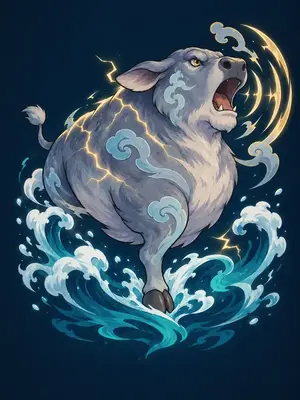
The Nian beast has no fixed appearance, because no old text describes it. Modern picture books and festival decorations usually draw a bulky four-legged animal with a lion's mane, a wide mouth full of teeth and a single horn. The image is close to the costume of the lion dance, and many people now say that the lion dance acts out the chasing away of Nian. Lion dances are described in Tang dynasty poetry, more than a thousand years before the Nian story can be traced, so that link is a later explanation.
Is Nian a dragon? No. It is sometimes drawn with scales and horns like the Chinese dragon, and the dragon dance shares the same festival, but the dragon is a bringer of rain and good fortune, while Nian is the thing being driven out.
Tellings from the twentieth century disagree about almost everything:
- In the earliest known mention, from 1933, it is an animal "like a dog yet not a dog", chained to a stone pillar.
- In a version printed in a Shanghai evening paper in 1959, it has two heads, four ears and eight legs and sleeps all year in a dark cave.
- In a version from the port city of Tianjin, recorded by the folklorist Lou Zikuang, it lives in the deep sea, and wherever it steps on shore the land floods, so people on the coast climb to high ground on New Year's Eve.
That much variety in so short a time is what a young story looks like while it is still settling into shape.
What nian really means: harvest, then year
In the old texts, nian is a word about grain. The earliest form of the character, on Shang dynasty oracle bones more than three thousand years old, shows a person carrying a stalk of grain, and diviners used it when asking whether the harvest would be good. The first Chinese dictionary still defines it that way.
秊:穀孰也。从禾千聲。
Nian: the grain is ripe. Formed from "grain", with "thousand" giving the sound.
Grain ripened once a year in north China, so the word for one harvest became the word for one year. The Erya, a glossary compiled around the third century BCE, lists it as the Zhou dynasty term among several names for the same thing.
載,歲也。夏曰歲,商曰祀,周曰年,唐、虞曰載。
Zai means a year. The Xia called it sui, the Shang called it si, the Zhou called it nian, and in the time of Tang and Yu it was called zai.
Tang and Yu are the reigns of the sage kings Yao and Shun. So guo nian, to pass the year, first meant exactly what it says. Researchers who have gone looking have not found a beast named Nian in any dictionary, classic or festival handbook from before the twentieth century. That silence is the main reason scholars treat the monster as a late arrival.
The older New Year demon: the shansao and exploding bamboo
The oldest explanation of why people make noise at New Year names a different creature. It comes from the Jingchu Suishi Ji, a record of the yearly customs of the middle Yangtze region written by Zong Lin in the sixth century. Its first entry reads:
正月一日,是三元之日也,謂之端月。鷄鳴而起。先於庭前爆竹,以辟山臊惡鬼。
The first day of the first month is the day of the three beginnings, and the month is called the Starting Month. People rise at cockcrow. First of all they explode bamboo in front of the courtyard, to drive off the shansao and evil ghosts.
The words translated "explode bamboo" are bao zhu, which is still the Chinese word for a firecracker. Before gunpowder it meant just that: green bamboo thrown on a fire, where the air sealed inside each joint heats up and bursts with a crack. Gunpowder packed in paper tubes took over from about the Song dynasty and kept the old name.
And the shansao? A book of marvels called the Shenyi Jing, traditionally credited to the Han dynasty courtier Dongfang Shuo but probably written some centuries later, describes them.
西方深山中有人焉,身長尺餘,袒身,捕蝦蟹。性不畏人,見人止宿,暮依其火以炙蝦蟹。伺人不在,而盜人鹽以食蝦蟹。名曰山臊。其音自叫。人嘗以竹著火中,爆烞而出,臊皆驚憚。犯之令人寒熱。
In the deep mountains of the west there are beings a little over a foot tall. They go bare-bodied and catch shrimp and crabs. By nature they have no fear of people: when they see travelers stop for the night, they come up to the fire at dusk to roast their shrimp and crabs. When the people are away, they steal their salt to eat with the shrimp and crabs. They are called shansao, after the sound of their own cry. People once put bamboo in the fire; it burst and shot out, and the sao were all startled and afraid. Whoever offends them comes down with chills and fever.
A Sui dynasty commentary on the Jingchu Suishi Ji quotes a slightly different version of this passage, in which the shansao has only one leg. One-legged mountain spirits are an old idea in China. In the Discourses of the States, Confucius is asked about a strange find and answers with a list of prodigies.
木石之怪曰夔、蝄蜽,水之怪曰龍、罔象,土之怪曰羵羊。
The prodigies of wood and stone are called kui and wangliang; the prodigies of water are called dragon and wangxiang; the prodigy of earth is called fenyang.
Wei Zhao, who annotated the book in the third century, adds that some say the kui has one leg and is the creature people call shansao, with a human face, a monkey's body and the power of speech. The name kui also belongs to the one-legged thunder beast Kui of the Shan Hai Jing.
So the creature that New Year firecrackers were first meant to scare was a foot-high, salt-stealing, fever-bringing mountain imp, not a man-eating giant. The skeleton of the Nian story is already here: something harmful comes around at the turn of the year, and it cannot bear a loud bang.
Red paper and door guardians: from peach wood to couplets
The red on the door has its own history, and it did not start as red paper. It started as peach wood. The same sixth-century handbook goes on:
造桃板著戶,謂之仙木。繪二神貼戶左右,左神荼,右鬱壘,俗謂之門神。
They make peach-wood boards and fix them to the door; this is called the wood of the immortals. They paint two gods and paste them to the left and right of the door, Shentu on the left and Yulü on the right. These are commonly called the door gods.
Peach wood was believed to frighten ghosts, and Shentu and Yulü were two brothers who, in an older legend, stood beneath a giant peach tree and seized any ghost that did harm. Over the following centuries the boards came to carry written charms and then lines of verse, and paper replaced wood. By the eleventh century the yearly change of peach charms was so familiar that the statesman and poet Wang Anshi could build a New Year poem on it.
爆竹聲中一歲除,春風送暖入屠蘇。千門萬戶曈曈日,總把新桃換舊符。
Amid the crack of bursting bamboo a year is gone; the spring wind carries warmth into the tusu wine. On a thousand gates and ten thousand doors the bright sun rises, and every house swaps its old peach charms for new.
Tusu was a spiced wine drunk at the New Year to keep off sickness. Firecrackers, protective wine, new charms on the door: the main pieces of the festival are all in these four lines, and there is no monster in them. The red paper couplets called chunlian descend from those peach boards, and the printed door gods pasted beside them are the same guards the sixth-century text describes. Our entry on Chinese gods has more on the door gods and on the Kitchen God, who also has work to do at the turn of the year.
Staying up on New Year's Eve
Sitting up through the last night of the year, called shou sui or "guarding the year", is also on record long before any beast story. Meng Yuanlao's memoir of Kaifeng, the Northern Song capital, describes New Year's Eve there in the early twelfth century. In the palace, more than a thousand performers dressed as generals, door gods, judges and the demon queller Zhong Kui marched out through the city gate to drive the evils of the old year away. Then:
是夜禁中爆竹山呼,聲聞於外。士庶之家,圍爐團坐,達旦不寐,謂之守歲。
That night the palace rang with exploding bamboo and shouts of "Long live!", loud enough to be heard outside. In the homes of gentry and commoners alike, families sat in a circle around the stove and did not sleep until dawn. This was called guarding the year.
The modern legend says families stay awake to watch for Nian. The Song dynasty account gives no reason at all beyond the fire, the noise and the company.
Where the Nian story first appears: Shanghai, 1933
So when does the beast itself turn up? According to research by a reference librarian at the Shanghai Library, reported in the Chinese press in 2019, the earliest known mention is in a Shanghai tabloid, Jingangzuan, on 17 January 1933. It comes in a serialized memoir of old Shanghai customs by the novelist and newspaperman Sun Yusheng, who was born in 1864 and was describing the New Year of his youth.
Sun describes the scroll paintings that families hung up after the year-end cleaning. One popular subject was Ziwei, the star god of the celestial pole. Painters, he says, showed a stone pillar with a beast chained to it that looked like a dog but was not a dog. Some people said it was the Heavenly Dog star. Others said it was a beast named Nian that always wanted to eat people, and that Ziwei kept it chained so it could not go down into the world and do harm. Sun added that he did not know where the explanation came from and had no way to check it.
A few things stand out. In 1933 Nian was one of two competing labels for a figure in a painting, not yet a story. It was the chained prisoner of a star god, not a raider of villages. And it had nothing to do with red paper or firecrackers. The other label is worth a note too: the Heavenly Dog, or Tiangou, is an old figure that the Shan Hai Jing describes as a beast that wards off evil and that later folklore blames for eclipses.
The fuller tale followed quickly. The same research found versions close to today's in a major Shanghai newspaper in 1939 and in a magazine in 1947, and from there the story spread through newspapers, children's books and classroom retellings across the Chinese-speaking world. Scholars in Taiwan were already questioning its age in the 1970s. The likeliest reading is that a twentieth-century story gathered up much older customs, once aimed at the shansao, ghosts and plague, and gave them a single memorable villain.
Nian today, and Chinese New Year 2027
Today Nian is everywhere at the Spring Festival: in picture books, school plays, animated films, video games and shopping mall displays. Outside China the legend is often the first thing children learn about the holiday, because it explains the red, the noise and the lights in one short story. These days the beast is drawn as a round, friendly mascot about as often as a monster.
In 2027, Chinese New Year falls on Saturday, 6 February, and begins the Year of the Goat, also translated as the Year of the Sheep or Ram. New Year's Eve, the night of the Nian story, is Friday, 5 February, and the Lantern Festival that closes the season is on 20 February.
Nian is a good reminder that a legend does not have to be old to be real folklore. People tell it, children act it out, and it has shaped how the festival is explained for close to a century. For beasts that do come from the ancient books, see our guide to Chinese mythical creatures and the Shan Hai Jing bestiary, or meet 43 of them as units in our free browser game Beasts of Shanhai. Guardian beasts with a longer paper trail include the pixiu and the qilin.
Questions
What is the Nian monster?
Nian is the beast of the Chinese New Year legend. It is said to have attacked villages on the last night of every year until people found that it feared the color red, firelight and loud noise.
How do you pronounce Nian?
Roughly "nyen", in one syllable. In Chinese the creature is called nian shou, which means year beast.
Is the Nian legend really ancient?
No. The New Year customs are very old, but no early Chinese text mentions a beast called Nian. The earliest mention found so far is in a Shanghai newspaper column from January 1933.
What is Nian afraid of?
Three things in most versions: the color red, fire or bright light, and loud noise such as firecrackers and drums.
Is Nian a dragon or a lion?
Neither. It has no fixed form; modern art usually gives it a lion-like body with a horn, and the earliest known description calls it "like a dog yet not a dog".
What does nian mean in Chinese?
It means year. The oldest dictionary defines it as ripe grain, because one harvest marked one year.
Why are firecrackers set off at Chinese New Year?
The oldest explanation, from a sixth-century text, is that exploding bamboo drives off the shansao, a small mountain demon, along with evil ghosts. The Nian explanation is modern.
When is Chinese New Year in 2027?
Saturday, 6 February 2027. It begins the Year of the Goat, also called the Year of the Sheep or Ram.
Related entries
- Chinese Mythology CreaturesOverviewThe creatures of Chinese myth by group: dragons, the Four Symbols, the four spirit animals, the Four Perils, Shan Hai Jing beasts and folk monsters.
- Chinese DragonCreatureThe long: a scaled spirit of water and rain that can shrink or grow at will, chief of all scaly creatures and the emblem of the emperor.
- Chinese GodsOverviewThe main Chinese gods by group: creators, sage kings, the Daoist heaven, Buddhist figures, gods of wealth and war, and the moon goddess Chang'e.
- PixiuCreatureA winged lion-like beast said to swallow wealth and never let it go. In the oldest texts it was a fierce animal and a symbol of brave troops.