Kunlun, the Sacred Mountain of Chinese Mythology
The Heavenly Emperor's capital on earth: a mountain ringed by water said to be too weak to float a feather and by fire that burns whatever touches it, kept by a tiger-bodied god and home to the Queen Mother of the West.
- Chinese name
- 昆仑 (Kūnlún)
- Also known as
- Kunlun Mountain, Mount Kunlun, Kunlun Hill, Kunlun Ruins
- Type
- Sacred mountain of myth
- Earliest sources
- Classic of Mountains and Seas, Huainanzi, Travels of King Mu, from about the 4th to the 2nd century BCE
- Ruled by
- The Heavenly Emperor; kept by the god Luwu
- Famous resident
- The Queen Mother of the West
- Known for
- Nine gates, trees of immortality and the source of the Yellow River
What is Kunlun?
Kunlun is the sacred mountain of ancient Chinese mythology, the place where the world of people touches the world of the gods. The oldest texts call it the Heavenly Emperor's capital on earth. Kunlun Mountain stands somewhere in the far northwest, it is enormously high, and it is surrounded by deep water and burning mountains so that almost no one can climb it. Trees of immortality grow on it, gods with the bodies of tigers guard its gates, and the Queen Mother of the West lives nearby.
There is also a real Kunlun range. It runs for thousands of kilometers across western China, along the northern edge of the Tibetan Plateau, and its name was taken from the myth, not the other way round. This entry is about the mythical mountain: what the earliest books say about it, who lives there, how later writers built a ladder to heaven on top of it, and why Kunlun is still the name to drop in Chinese fantasy.
Kunlun matters especially to our Shan Hai Jing bestiary. Three of its beasts live on Kunlun Hill: the warden god Luwu, the four-horned ram Tulou and the stinging bird Qinyuan. For the bigger picture, start at Chinese mythology.
The Heavenly Emperor's capital on earth
The first full description of Kunlun is in the Classic of Mountains and Seas, the Shan Hai Jing, in its third book of the Western Mountains. The book walks the reader from mountain to mountain, giving distances in li, and then reaches a hill unlike any other.
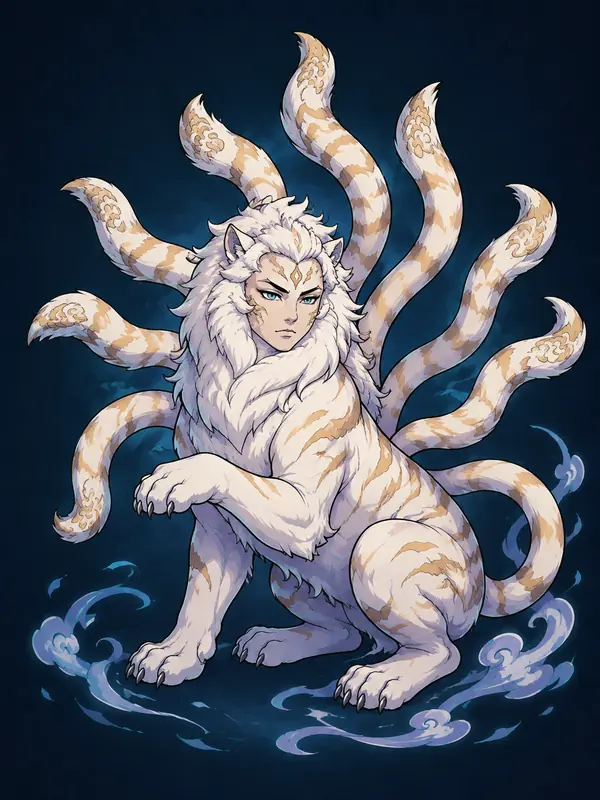
西南四百里,曰昆侖之丘,是實惟帝之下都,神陸吾司之。其神狀虎身而九尾,人面而虎爪;是神也,司天之九部及帝之囿時。
Four hundred li to the southwest is Kunlun Hill. This is truly the Emperor's capital on earth, and the god Luwu keeps it. He has a tiger's body with nine tails, a human face and tiger claws. This god is in charge of the nine regions of heaven and the seasons of the Emperor's parks.
The Emperor here is the Heavenly Emperor, the supreme god, and Kunlun is his residence on earth, the way a ruler might keep a palace outside the capital. The same passage then lists what else lives on the hill:
- The Tulou, a beast like a ram with four horns, which eats people.
- The Qinyuan, a bird like a bee but as big as a mandarin duck. Any bird or beast it stings dies, and any tree it stings withers.
- The chun bird, which looks after the Emperor's clothing and belongings.
- The shatang tree, like a crab apple with yellow flowers and red fruit that tastes like a plum without a stone. Eating it keeps you from drowning.
- The pin herb, shaped like a mallow and tasting like a spring onion, which cures fatigue.
Four rivers rise on the hill: the Yellow River flowing south, the Red River flowing southeast, the Yang River flowing southwest and the Black River flowing west. The passage ends by saying the mountain has many strange birds and beasts. A little earlier in the same book, from a neighboring mountain, the text looks south toward Kunlun and says its light blazes and its vapors swirl.
Nine gates, nine wells and the Kaiming beast
A later part of the Classic of Mountains and Seas, the Classic of Regions Within the Seas, describes Kunlun again, this time as the Ruins of Kunlun, and gives it measurements, walls and a gatekeeper.
海內昆侖之虛,在西北,帝之下都。昆侖之虛,方八百里,高萬仞。上有木禾,長五尋,大五圍。面有九井,以玉為檻。面有九門,門有開明獸守之,百神之所在。
The Ruins of Kunlun within the seas lie in the northwest, the Emperor's capital on earth. The Ruins of Kunlun are eight hundred li on each side and ten thousand ren high. On top grows a grain tree five xun tall and five spans around. On each side there are nine wells with railings of jade, and nine gates, and the gates are guarded by the Kaiming beast. It is the place of the hundred gods.
A ren is the height of a man with his arms raised, so ten thousand ren is a mountain of absurd height. The same chapter says that no one but the archer Yi, the hero who shot down the extra suns, could climb its cliffs.
The guardian of the gates is the Kaiming beast, whose name means "opening into brightness". It has a body like a huge tiger and nine heads, each with a human face, and it stands on top of Kunlun facing east. Around it the text sets a garden of wonders. To the west of the Kaiming beast live phoenixes and luan birds, the birds of good omen we cover under the Fenghuang. To its north grow pearl trees, patterned jade trees and the tree of immortality. To its east stand six shamans, among them Wu Peng and Wu Yang, holding the drug of immortality around the corpse of a murdered god, trying to bring him back to life.
Put the two descriptions together and Kunlun looks less like a mountain than a walled holy city: square, gated, guarded by tiger-gods, with water and plants that defeat death. Both pictures were drawn by different hands at different times, and the Classic of Mountains and Seas never makes them fully agree.
Weak Water, the mountain of fire and the Queen Mother of the West
The Classic of the Great Wilderness, the last and probably latest part of the Classic of Mountains and Seas, explains why no ordinary person ever reaches Kunlun. It also introduces the mountain's most famous neighbor.
西海之南,流沙之濱,赤水之後,黒水之前,有大山,名曰崑崙之丘。有神,人面虎身,有文有尾,皆白,處之。其下有弱水之淵環之,其外有炎火之山,投物輒然。有人,戴勝,虎齒,有豹尾,穴處,名曰西王母。
South of the Western Sea, on the shore of the Flowing Sands, behind the Red River and before the Black River, there is a great mountain called Kunlun Hill. A god with a human face and a tiger's body, striped and tailed and all white, lives there. Below it a gulf of Weak Water rings it round, and beyond that is a mountain of blazing fire: anything thrown onto it bursts into flame. There is a person who wears a sheng headdress, has tiger's teeth and a leopard's tail, and lives in a cave. She is called the Queen Mother of the West.
Weak Water is water too thin to hold anything up. Later commentators say that not even a goose feather will float on it, so no boat can cross. Inside the ring of Weak Water is a ring of fire. Kunlun is sealed twice over.
The Queen Mother of the West, Xiwangmu, started as a frightening figure. The Western Mountains book places her on Jade Mountain, a little further west, and describes her as shaped like a person, with a leopard's tail and tiger's teeth, good at whistling, with wild hair and a sheng headdress, in charge of heaven's plagues and punishments. Over the following centuries she became a beautiful and gracious goddess, the queen of immortals, who rules a paradise on Kunlun and grows the peaches of immortality. The archer Yi went to her for the elixir of immortality, and in the version told by the Huainanzi his wife Chang'e stole it and fled to the moon. In Journey to the West, her peach banquet is the party the Monkey King wrecks.
Three levels to heaven in the Huainanzi
The Huainanzi, a book compiled at the court of Liu An, the king of Huainan, in the second century BCE, turns Kunlun into a ladder to heaven. Its chapter on the shape of the earth says that Yu the Great, the hero who tamed the great flood, dug out the Ruins of Kunlun and built on it a walled city nine layers high. It describes 440 gates, nine wells with jade railings, trees of pearl, jade and immortality, and a river of red water that keeps you from dying if you drink it. Then it explains what happens as you climb.
昆侖之丘,或上倍之,是謂涼風之山,登之而不死。或上倍之,是謂懸圃,登之乃靈,能使風雨。或上倍之,乃維上天,登之乃神,是謂太帝之居。
Above Kunlun Hill, at twice the height, is the Mountain of Cool Wind: climb it and you do not die. At twice that height is the Hanging Garden: climb it and you gain spirit power and can command wind and rain. At twice that height again you reach heaven itself: climb it and you become a god. That is the dwelling of the Great Emperor.
This is the clearest statement of what Kunlun means in Chinese myth. It is the pillar between earth and heaven, and each stage of the climb raises you one step from mortal to immortal to god. The same chapter says the four rivers that flow from Kunlun are the divine springs of the Emperor, used to blend the hundred medicines and to nourish all living things. Right after the three levels it turns to the Jian tree, which stands at the center of heaven and earth and which the gods use to climb up and down.
King Mu's visit to Kunlun
The Travels of King Mu, a book found in a tomb around 280 CE, tells of a Zhou dynasty king who drives his eight famous horses to the far west. On a lucky day he climbs Kunlun Hill to see the palace of the Yellow Emperor, then travels on to meet the Queen Mother of the West. She is not a monster here but a dignified ruler. He presents her with jade and silk, and she hosts him at the Jasper Pool, where she sings to him.
白雲在天,丘陵自出。道里悠遠,山川間之,將子無死,尚能復來。
White clouds are in the sky, and the hills rise up on their own. The road between us is long, with mountains and rivers in the way. If you do not die, you may still come back again.
The king answers that he will go home, put his lands in order, and return in three years. The book never says that he did. The Jasper Pool, Yaochi, became in later tradition the name of the Queen Mother's lake on Kunlun and the site of her banquets.
Where is Kunlun? Myth meets the map
Where Kunlun stood was a real question for the Han dynasty, because the Yellow River was supposed to rise there. In the second century BCE the envoy Zhang Qian and the Han missions that followed him traveled into Central Asia. Sima Qian's Records of the Grand Historian reports how the emperor settled the matter.
而漢使窮河源,河源出于窴,其山多玉石,采來,天子案古圖書,名河所出山曰崑崙云。
The Han envoys traced the river to its source. It rose in Khotan, in mountains full of jade, which they gathered and brought back. The Son of Heaven checked the old maps and books and named the mountains where the river rises Kunlun.
Sima Qian himself did not believe the old stories. In his comment at the end of the same chapter he quotes an older book that says Kunlun is more than 2,500 li high, with a sweet spring and a Jasper Pool on top, and then asks where the envoys who had searched out the source of the river had seen any such thing. He adds that he does not dare speak about the monsters in that older book or in the Classic of Mountains and Seas.
That decision by Emperor Wu is why the real Kunlun range carries the name today. The jade of the region was already famous: the Huainanzi lists the qiulin and langgan jades of Kunlun as the treasures of the northwest.
Kunlun in later religion and stories
In later tradition Kunlun became the western paradise of Chinese religion, paired with Penglai, the island of immortals in the eastern sea. Daoist writers filled it with palaces of gold and jade ruled by the Queen Mother of the West, and Kunlun became shorthand for the home of immortals. Some versions make it the seat of the highest Daoist gods; in the Ming novel Investiture of the Gods, the great teacher of one school of immortals keeps his palace on Kunlun Mountain.
Feng shui borrowed the mountain too. Because all the great rivers were thought to flow from Kunlun, later geomancers described the mountain ranges of China as dragon veins running out from it. Journey to the West uses the idea in passing: the mountain of the Daoist temple where the ginseng fruit grows is described as having roots joined to the veins of Kunlun. Today Kunlun is one of the most common names in Chinese fantasy, used for sects, swords, mountains and heavenly realms, and is often the setting for stories about the gods and the Jade Emperor.
Kunlun in our bestiary and game
Kunlun is one of the few places in the Classic of Mountains and Seas where several of our beasts live side by side. On our bestiary pages you can read the original lines for each of them, with our translation and a Ming dynasty woodblock picture where one survives:
- Luwu, the tiger-bodied, nine-tailed god who keeps Kunlun for the Heavenly Emperor.
- Tulou, the four-horned ram of Kunlun that eats people.
- Qinyuan, the bee-shaped bird whose sting kills animals and withers trees.
- Fenghuang, the phoenix, which the Classic of Regions Within the Seas places west of the Kaiming beast.
These creatures also appear in our free game Beasts of Shanhai, where the beasts of the old book are sorted by the five elements. For more of the world around Kunlun, see our entries on the creatures of Chinese mythology and the gods of Chinese mythology.
Questions
What is Kunlun in Chinese mythology?
Kunlun is the sacred mountain where the gods live, described in the oldest texts as the Heavenly Emperor's capital on earth. It is guarded by tiger-bodied gods, ringed by Weak Water and fire, and home to plants and springs that give immortality.
Is Kunlun Mountain real?
There is a real Kunlun range in western China, but it was named after the myth. In the second century BCE the Han emperor gave the old mythical name to the mountains where his envoys believed the Yellow River began.
Who lives on Kunlun?
The Heavenly Emperor has his earthly capital there, kept by the god Luwu. The nine-headed Kaiming beast guards its gates, and the Queen Mother of the West lives on or near it. The Shan Hai Jing also places the Tulou ram and the Qinyuan bird there.
How do you pronounce Kunlun?
Roughly "kwun-lwun", close to "koon-loon", with the two syllables rhyming. In Mandarin the first syllable has a level tone and the second a rising tone.
What is the Weak Water around Kunlun?
A gulf of water too weak to hold anything up. Later commentators say not even a feather will float on it, so no boat can cross. It is one of two barriers around the mountain, together with a mountain of fire.
What is the difference between Kunlun and Penglai?
Both are homes of immortals. Kunlun is a mountain in the far west, linked to the Queen Mother of the West. Penglai is an island in the eastern sea that early emperors sent expeditions to find.
Related entries
- Chinese GodsOverviewThe main Chinese gods by group: creators, sage kings, the Daoist heaven, Buddhist figures, gods of wealth and war, and the moon goddess Chang'e.
- Chinese Mythology CreaturesOverviewThe creatures of Chinese myth by group: dragons, the Four Symbols, the four spirit animals, the Four Perils, Shan Hai Jing beasts and folk monsters.
- Journey to the WestOverviewThe Ming dynasty novel of the monk Tang Sanzang, the Monkey King and their companions on a pilgrimage to India: authorship, plot, ordeals and demons.
- Chang'eGodThe goddess of the moon, wife of the archer Hou Yi. She took his elixir of immortality and has lived in the moon palace ever since.
- Jade EmperorGodThe supreme ruler of heaven in Chinese popular religion: his Daoist birth story, his court of gods, his war with Sun Wukong and his New Year birthday.
- Sun WukongHeroThe Monkey King of Journey to the West: born from a stone, master of 72 transformations, rebel against heaven and finally a Buddha.
From the Shan Hai Jing bestiary
 Lu Wu 陆吾A god with a tiger's body, nine tails, a human face and tiger claws, who guards Kunlun for the Heavenly Emperor.
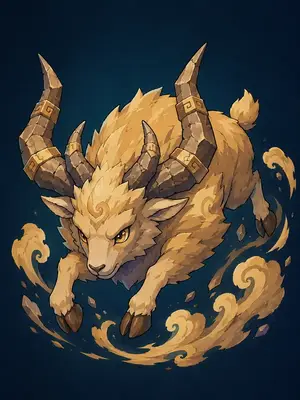 Tulou 土蝼A ram with four horns that eats people, living on Kunlun Hill among the guardians of heaven's earthly capital.
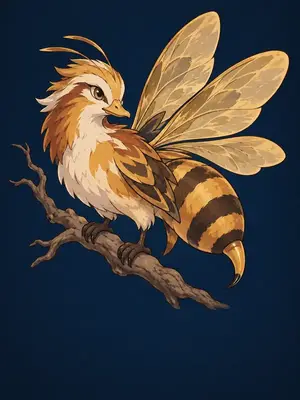 Qinyuan 钦原A bird shaped like a bee and as big as a mandarin duck. Its sting kills birds and beasts and withers trees.
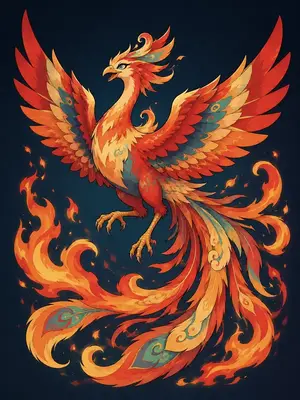 Fenghuang 凤皇A five-colored bird like a rooster whose markings spell out virtues. When it appears, the world is at peace.